KonnectX
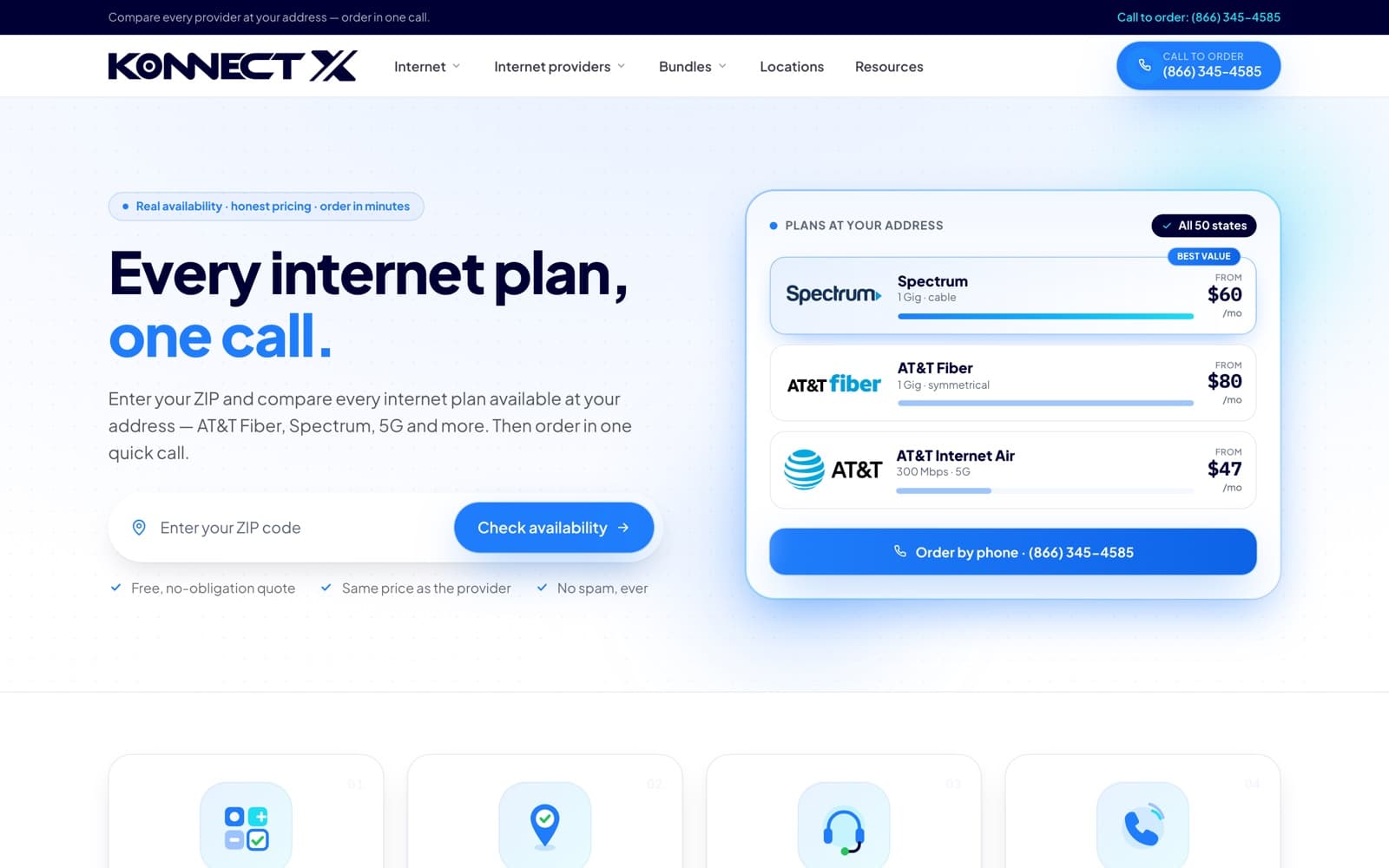
A home-internet marketplace for the United States: enter a ZIP, see every plan wired to that address, and order it on one call.
What they came with
Buying home internet in the United States means checking providers one at a time, and the answer that comes back is usually for the city or the ZIP rather than for the address on the bill. A household ends up with five tabs open, no way to line the plans up beside each other, and no confidence that any of it is actually wired to their street. The order itself finishes on a phone call with a specialist, so a site that only lists plans leaves the hard part, working out what can be ordered at that address, to the caller.
What the build had to do
Availability at the address, not the city
A ZIP lookup resolves to the providers and plans actually serving that address, so the comparison starts from what a household can order today.
One catalogue behind every surface
Fiber, cable, 5G, satellite, DSL and fixed wireless plans, with providers, speeds, pricing and technology modelled once and read by every page.
Pages for the long tail of search
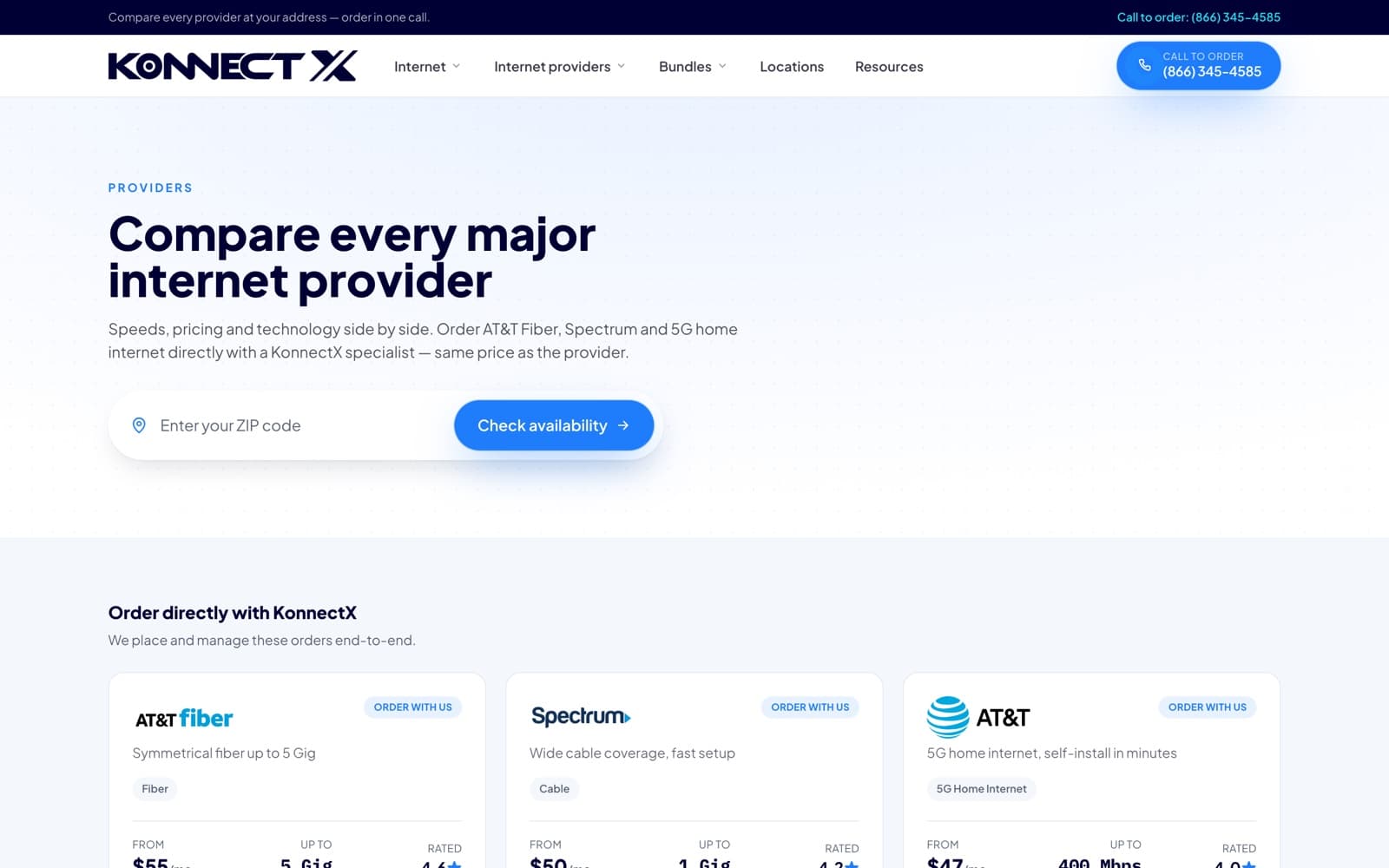
Provider pages, plan-type pages, bundles and location pages are generated from that catalogue, so a search for a provider in a place lands on a real page rather than a filtered list.
A call-first conversion path
Ordering happens on the phone with a specialist, so click-to-call sits on every surface, on desktop and as a fixed bar on mobile where most of the traffic is.
Tools and editorial that arrive first
A speed test and a library of buying guides bring visitors in before they are ready to switch, and hand them to the same comparison when they are.
Technical detail
Serviceability resolved before anything renders
The ZIP a visitor types resolves to the set of providers and plans marked as serving that address, and the comparison, the plan cards and the call prompt all read from that resolved set. Nothing on the page is a national list filtered after the fact, so a household is never quoted a price for a plan that cannot reach them.
One catalogue behind generated routes
Providers, plans, speeds, price and access technology are modelled once, and the plan-type pages, the bundle pages, the provider pages and the state and city tree are all rendered from those records. A speed or a price changes in the catalogue rather than on the pages that quote it.
Prerendered pages with timed revalidation
The long tail is built as static HTML served from the edge and revalidated on a timer rather than rendered per request, so a first-time visitor arriving from search gets a document instead of waiting on a render. The trade-off is a bounded window in which a page can still show a figure the catalogue has just changed, so that window is kept short on the surfaces that carry price.
A call path built for mobile
Because the order completes on the phone, the conversion element is a tel: link rather than a form, repeated on every template and pinned to the bottom of the viewport on small screens. The page reserves that height in its own layout, so the bar sits below the last row of a comparison table instead of on top of it.
The stack
Frontend
Rendering
Infrastructure
- Sector
- US home internet
- Scope
- Design, build, content surface
- Shape
- Comparison and ordering site
- Conversion
- Phone-led, with a specialist

Something like this to build?
Tell us what runs today and where it hurts. An engineer reads it and replies.