Manufacturing

Software that knows what the plant can actually make this week

We build production planning, inventory, quality and plant integration systems for manufacturers, so the run sheet, the stock count and the ledger all read from the same records.

The sector

Production runs on numbers that have to agree

Most plants run on more systems than anyone planned. An ERP that stops at the office door, a scheduling spreadsheet a supervisor rebuilds every Monday, a historian on the line that nobody reads, and a clipboard for the quality checks. Each one is right about its own piece and none of them agree on what the plant can ship this week.

The cost shows up as decisions made on stale numbers. A run is planned from a stock figure taken before the last scrap report. Purchasing orders a material that is already sitting in the wrong warehouse. A customer asks which raw lots went into a batch and the answer means a search through paper travellers.

We build the layer that makes those numbers one set. Tradivoo, our own management system for trading and production businesses, plans the next run from sales history, pre-orders and stock on hand, and rolls it down into batches and the components each batch consumes, whether that structure is a recipe with sub recipes or a bill of materials with sub assemblies. Where an ERP exists, we build around it.

What makes it hard

The constraints that shape manufacturing systems

Supply that moves under the plan

Lead times slip, a supplier substitutes a grade, a minimum order quantity forces a buy you did not want. Purchasing reacts in email while the schedule and the stock system carry on as if nothing changed.

Data trapped on the floor

Lines expose data in whatever their controller supports, and older machines expose almost nothing. Counts, downtime and reject reasons end up written on a clipboard and typed in later, if at all.

Nobody knows what a run cost

The quote used a standard cost set some time ago. What the batch actually consumed, the scrap, the rework and the price the material was really bought at, is reconciled later, by which point the next quote has gone out.

Traceability that lives on paper

A recall or a customer audit asks which raw lots went into which finished batch and which operator signed the check. That chain usually sits in batch sheets in a filing cabinet, not in a system anyone can query.

What we build

Systems we ship for manufacturing teams

Production planning and scheduling

A plan built from sales history, pre-orders, par levels and stock on hand, rolled down into batches and components. The approved plan is laid against lines and shifts in changeover order, so a rush order shows what it pushes back.

Inventory and purchasing across locations

On-hand, reorder level and available units for every part in every warehouse, with in-transit stock kept separate. Reorder suggestions come from live stock and lead times, and purchase orders carry landed cost and match against packing lists on receipt.

Plant systems and machine data

Collectors that read from controllers, historians and file drops, plus operator terminals for the lines that expose nothing. Data buffers locally when the network drops and syncs when it returns, so a bad hour does not lose a shift.

Quality checks and lot traceability

In-process checks captured at the station rather than on paper, with limits, sign-off and non-conformance handling. Lot genealogy links raw material receipts to finished batches, so a trace query returns an answer instead of a search.

What a run actually cost

Materials actually consumed at the price actually paid, plus labour hours, scrap and rework, costed per batch and set against the standard. Supplier invoices and certificates are read and extracted rather than retyped by the buying desk.

Proof

Screens from systems in production

app.tradivoo.com/production/forecast
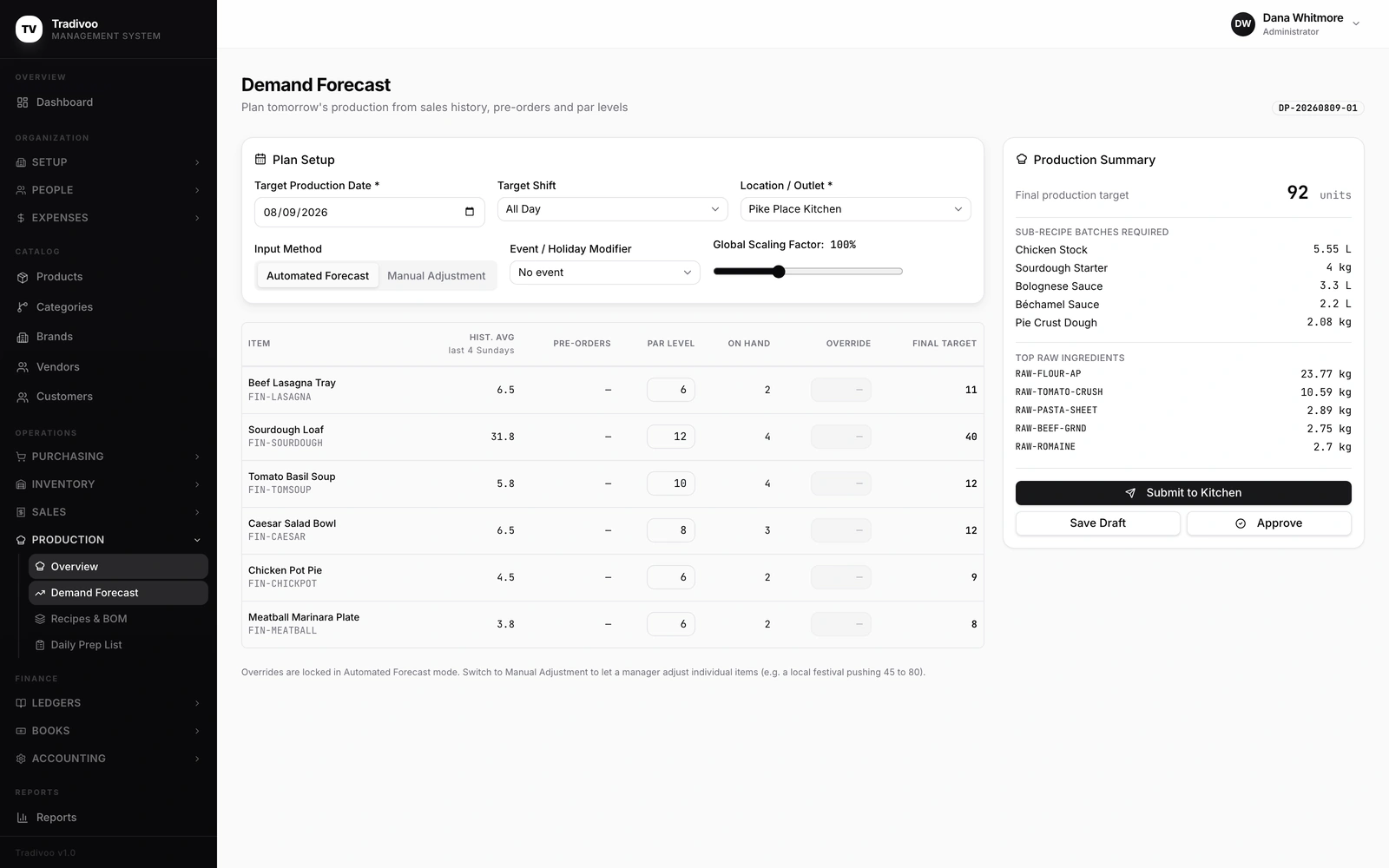
Tradivoo demand forecast planning tomorrow's production
Demand Forecasting · Food Production

Tomorrow's production planned from sales history and par levels

Tradivoo's demand forecast plans the next production run for a kitchen or plant from the last four weeks of sales, pre-orders, par levels and stock on hand. It rolls the finished goods into sub-recipe batches and raw ingredient quantities, so the kitchen gets a prep list, not a spreadsheet.
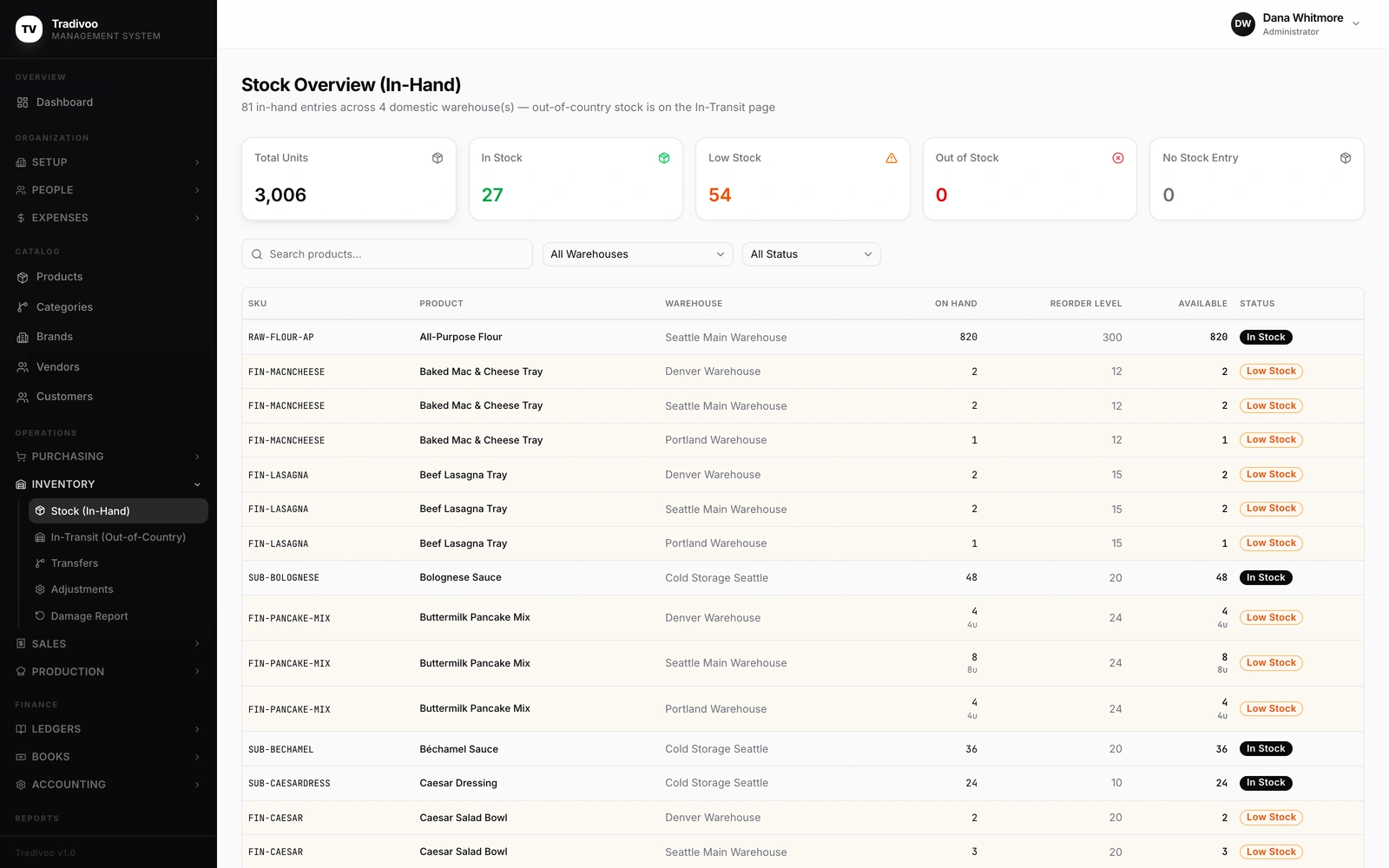
app.tradivoo.com/inventory/stock
Tradivoo stock overview across warehouses with reorder levels and status
Inventory · Trading Operations

Stock across every warehouse, with reorder levels that flag themselves

Tradivoo's stock overview shows on-hand, reorder level and available units for every SKU in every warehouse, with in-transit stock kept on its own page. Low-stock lines surface on their own, transfers and adjustments are logged, and the same numbers feed purchasing and the books.

FAQ

Questions we get before we start

Still unresolved? A 30-minute conversation with an engineer usually settles it faster than another page of copy.

No. Often the existing ERP handles finance and orders well enough and falls short on the floor. We usually build the planning, inventory and quality layer around it and integrate, so the ERP stays the system of record for what it is good at. Replacement is a decision we would only recommend if the existing system is genuinely blocking you.

It depends on what each line exposes, and we survey that first. Modern controllers and historians give us a clean read. Older machines might offer a serial output, a file drop or nothing at all, in which case we capture at an operator terminal instead, with reject reasons and downtime codes as a short list the operator can hit rather than type.

On your own hardware in the plant or in your cloud account, and the choice usually comes down to how reliable the link out of the plant is. Floor terminals and collectors keep working and buffer locally when they lose the network, so a bad hour does not cost you a shift of records. The data is yours, in a schema we document, and you can export all of it whenever you want.

Yes. The planning model works on a structure, and that structure can be a recipe with sub recipes or a bill of materials with sub assemblies. Both roll a demand figure down into what each unit consumes. Where discrete work differs is routing and changeover, and that is scheduling, which we build against your lines and shifts. The food specific parts, hold and release for example, are optional.

Building something for manufacturing?

A 30 minute conversation with an engineer is usually enough to scope it honestly.