Custom Software

Software shaped to your business, not the other way around

Off-the-shelf tools force your processes into someone else's mold. We build custom platforms engineered around how your business actually works: robust, scalable, and clean enough to evolve for years.

OverviewSoftware · Custom Software

When the tool should fit the work, you build the tool

Every growing company hits the same wall. The spreadsheets, the patchwork of SaaS subscriptions, and the manual workarounds that got you here start to cost more than they save. Data lives in five places and agrees in none. The process that's actually your competitive advantage is trapped in someone's head or a brittle automation no one dares touch. At some point, the software has to be built around the business instead of the business bending around the software.

Custom software development is the engineering of systems designed specifically for your processes, your data, and your users, rather than configuring a generic product to approximate them. It spans internal tools that eliminate manual work, customer-facing platforms that become the product itself, integrations that make disconnected systems behave as one, and the data and infrastructure layer underneath it all. The value isn't novelty; it's fit. Software that matches your reality removes friction that generic tools quietly impose every day.

The case for building is strongest exactly where it matters most: the processes that differentiate you. No vendor will build your competitive advantage for you, and bending it to fit their roadmap erodes the edge. Custom software also compounds. It becomes an asset you own and improve. A subscription's direction is set by its vendor; yours is set by you. The risk has always been execution: custom projects have a reputation for running over, under-delivering, and becoming unmaintainable. That reputation comes from how they're usually staffed and run.

Villaex builds custom software the way a product company builds its own product, because that's what we are. Senior engineers, clean architecture, tight iterations, real testing, and a bias toward shipping working software early and often. We make boundaries explicit, keep systems understandable, and design for the change that's coming, because the only certainty in software is that requirements will evolve. The outcome is a platform you can trust, operate, and extend for years rather than a black box you're afraid to touch.

PipelineSoftware

From input to outcome

How a platform gets from an operational problem to a system your team owns, with a reviewable artefact at every handover.

Process mapping

Workshops map the real workflow, its constraints and the metric that moves.

In
Your operation
Out
Scoped requirements

Architecture

Data model, services and integrations are designed before code is written.

In
Scoped requirements
Out
Technical design

Build & test

Two-week iterations, automated tests and review on every increment.

In
Technical design
Out
Release candidate

Live platform

Shipped with CI/CD, observability, backups and a rehearsed rollback.

In
Release candidate
Out
Running system

Feedback edge

Production telemetry and usage set the scope of the next iteration.

Where this work usually breaks down

The pain that pushes companies toward custom software is remarkably universal.

Process trapped in spreadsheets

Critical workflows held together by manual files and tribal knowledge: fragile, error-prone, and impossible to scale.

Disconnected systems

Data scattered across tools that don't talk, forcing double entry, reconciliation, and reports that are always slightly wrong.

SaaS that almost fits

Generic products that handle eighty percent of the need and fight you on the twenty percent that actually matters.

Legacy systems holding you back

Aging software that's expensive to maintain, impossible to extend, and a growing security liability.

Projects that overrun

Custom builds that miss deadlines and budgets because they're staffed with juniors and run without discipline.

Software no one can maintain

Tangled codebases that become so risky to change that the business slows down around them.

Our approach

We've built our practice specifically to avoid the ways custom software usually goes wrong.

Discovery before code

We map the real process, constraints, and success metrics first, so what gets built is the right thing.

Senior-only engineering

Experienced builders from day one. The quality of the people is the single biggest predictor of how a custom project goes.

Clean, documented architecture

Explicit boundaries, sensible patterns, and documentation that keep the system understandable and safe to change.

Iterative delivery

Working software every two weeks with demos, so scope and direction adjust early and cheaply.

Built-in quality

Automated testing, code review, CI/CD, and observability are standard practice here.

Designed for change

We architect for next year's requirements as well as the ones on today's list.

Selected Work

Proof, in production

Real systems, shipped and running: the interface, the data model, and the workflows they replaced.

ERP · Trading Business

One management system for stock, sales, purchasing and books

Tradivoo is a management system for trading and production businesses: products, vendors and customers, purchasing and landed cost, inventory across warehouses, point of sale, ledgers and books. The dashboard reads revenue, margin and receivables from the same records the operations run on.

  • Purchasing, inventory, sales and accounting on one data model
  • Multi-warehouse stock and point of sale
  • Ledgers and books that reconcile to operations
app.tradivoo.com/dashboard
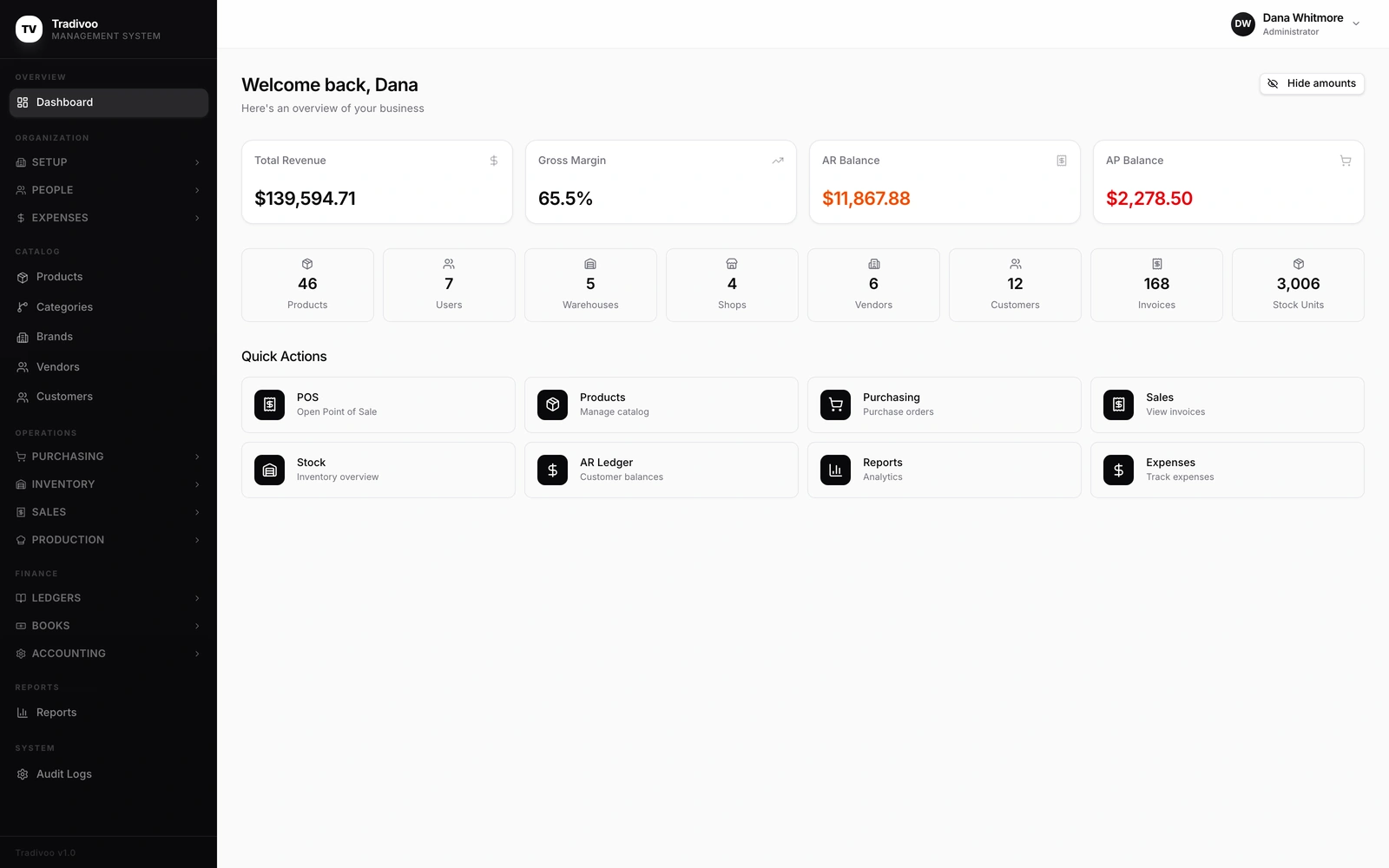
Tradivoo management dashboard with revenue, margin, receivables and quick actions
Custom Platform · Logistics

One platform replaced a decade of spreadsheets

A national logistics operator ran dispatch on spreadsheets, phone calls, and a system no one fully understood. We built a custom dispatch-and-tracking platform with real-time assignment, a driver app, live status, and automated customer notifications. It integrates with their accounting, on architecture documented for their own team to extend.

  • Real-time dispatch with a live operational view
  • Driver mobile app and automated customer updates
  • Clean, documented architecture owned by their team
dispatch.freightline.co/board

Dispatch board

Thu 12 Mar · 11 active
All lanes
MBDWNO
New load
Unassigned4
LD-88214

Reno NVBoise ID

53' Dry van · 18,400 lb

?Assign driver14:00
LD-88219

Fresno CATucson AZ

53' Reefer · 22,100 lb

?Assign driver16:30
LD-88223

Ogden UTCasper WY

48' Flatbed · 31,800 lb

?Assign driver18:15
LD-88231

Yakima WAEugene OR

53' Reefer · 16,900 lb

?Assign driver21:00
En route4
LD-88190

Denver COOmaha NE

53' Dry van · 26,500 lb

MBMarcus Bell19:40
LD-88186

Salt LakePortland OR

53' Reefer · 19,200 lb

DWDana Whitlock23:05
LD-88178

Amarillo TXWichita KS

48' Flatbed · 28,700 lb

IPIvan Petrov+45m
LD-88174

BakersfieldLas Vegas NV

53' Dry van · 21,300 lb

NONia Okafor17:20
Delivered3
LD-88141

Phoenix AZEl Paso TX

53' Dry van · 24,000 lb

SMSofia Marino06:42
LD-88137

SacramentoReno NV

53' Reefer · 17,300 lb

KAKwame Adjei05:18
LD-88129

Billings MTFargo ND

48' Flatbed · 30,400 lb

ERElena Ruiz04:55

What we build and deliver

A full-stack capability that covers everything from the database to the pixel.

Web Platforms

Customer-facing applications and internal tools built on modern, fast, maintainable foundations.

SaaS Products

Multi-tenant products with billing, auth, and the architecture to scale from first customer to thousands.

Workflow Automation & Integrations

Systems that eliminate manual steps and enforce process, joined by clean APIs and integration layers that make the disconnected tools your teams already use behave as one coherent platform.

Data Platforms

Pipelines, warehouses, and dashboards that turn scattered data into a single, trustworthy source of truth.

Legacy Modernization

Re-architecting aging systems for performance, security, and a future you can build on.

Use cases

Where it creates value

Different shapes, same principle: software built to fit the work.

Operations

Internal platforms

Custom tools that replace the spreadsheets and the manual steps around them. The process stops living in files and tribal knowledge. What replaces it is a system your team actually wants to use.

Startups

MVP to scale

Fundable products built fast, on architecture that won't have to be thrown away when you grow.

Enterprise

Line-of-business systems

The systems that run the core of the business. Complex domain software, built to last.

Logistics

Tracking & dispatch

Real-time operational systems for dispatch and tracking. They coordinate people, assets, and inventory at the scale the operation actually runs at.

Finance

Automated reporting

Platforms that automate reporting and stay auditable while they do it.

Compliance

Regulatory controls

The controls regulators require, enforced by the system itself.

Healthcare

Practice & patient systems

HIPAA-aligned platforms for scheduling and records. The workflows around them respect clinical reality.

Business outcomes

The return on the work

What a platform built for your business actually returns.

Hours → minutes
Process accelerationManual workflows automated end to end, giving your team their week back.
1
Source of truthData unified across the business, so everyone works from the same, current numbers.
Years
Useful lifespanArchitecture that evolves with the business instead of being rebuilt every eighteen months.
Full
OwnershipAn asset you own and control, roadmap included.
How we deliver

How the work actually runs

A disciplined delivery model that makes custom software predictable.

  1. Discovery

    We start by understanding the business, not the brief. Workshops with your team map goals, constraints, data, and the metrics success will be measured against, before anyone writes a line of code.

  2. Planning & Architecture

    We translate the problem into a system: data flows, model choices, interfaces, integrations, and a delivery plan broken into milestones you can evaluate at each step.

  3. Design

    Experience and technical design happen together. We prototype the critical flows early so stakeholders can react to something real instead of a slide deck.

  4. Development

    Senior engineers build in tight, two-week iterations. Every increment is reviewed, tested, and demoed, so progress is visible and course-corrections are cheap.

  5. Testing & QA

    Automated tests, security reviews, performance profiling, and human QA run continuously, not as an afterthought. We ship when it's genuinely ready.

  6. Deployment

    We harden infrastructure, set up CI/CD, observability, and rollback safety, then ship to production with a launch plan that protects uptime and data.

  7. Support & Scale

    After launch we monitor, optimize, and evolve. As usage grows, the architecture grows with it, and the same team that built it keeps it healthy.

The stack we build on

Frontend

Next.jsReactTypeScriptTailwind CSS

Backend

Node.jsPythonFastAPIPostgreSQLRedis

Infrastructure

AWSAzureGCPDockerKubernetesTerraform

Quality

PlaywrightVitestpytestGitHub ActionsGrafana

Industry coverage

SaaSFinanceHealthcareLogisticsRetailManufacturingEducationReal Estate
FAQ

Questions we get before we start

Still unresolved? A 30-minute conversation with an engineer usually settles it faster than another page of copy.

Buy when a generic product genuinely fits: accounting, email, CRM basics. Build when the process is your competitive advantage, when no product fits without painful compromise, or when integrating several tools costs more than one purpose-built system. We'll tell you honestly which situation you're in.

It depends entirely on scope, but we make it predictable. We propose a fixed-scope first phase so you can evaluate the work and the relationship before committing to the full build, and we work in increments so spend tracks visible progress.

A focused MVP typically takes two to four months; a larger platform, six months and up. We deliver working software every two weeks, so you're never waiting until the end to see results.

No. You own the code, the infrastructure, and the documentation. We design for your team to operate and extend the system, and we run knowledge-transfer sessions at handover. A healthy relationship is one you could leave, so we earn it instead.

Yes. Most of our work integrates with systems already in place: CRMs, ERPs, accounting, data warehouses. Clean integration is often the highest-value part of the project.

They will, and our process expects it. Iterative delivery means changing direction is cheap. We adjust scope at iteration boundaries instead of discovering a mismatch at the end.

Yes. We offer ongoing support and evolution, and because the same team built it, that support is fast and informed. We also set you up to operate it independently if you prefer.

Automated testing, code review on every change, CI/CD, and observability are standard. Quality isn't a phase at the end; it's built into how we work every day.

Often, yes. We start with an assessment of the codebase and situation, then recommend whether to stabilize and continue or re-architect. We're candid about which path serves you best.

Now taking new projects

Build software that fits.

Describe the process that's holding you back. We'll show you what a platform built for it looks like.