Process Automation

Automate the work no one should be doing by hand

Every business runs on repetitive, rules-heavy tasks that quietly consume your team's hours. We automate them with AI-powered workflows: document processing, data entry, approvals, and cross-system orchestration that run reliably at scale.

OverviewAI · Process Automation

Your best people are doing work a machine should do

In every organization, a surprising amount of skilled time goes to work that requires no skill: copying data between systems, processing the same kind of document over and over, chasing approvals, reconciling spreadsheets, re-keying information a customer already provided. It's invisible because it's spread across teams and treated as 'just how things work.' But add it up and it's enormous: hours every day, across every department, spent on tasks that are repetitive, rules-based, and perfectly suited to automation.

Business process automation is the practice of identifying that work and handing it to software. Traditional automation (RPA) handled the rigid, structured parts, clicking through systems and moving data on fixed rules. AI has expanded what's automatable dramatically: language models can read and understand documents, extract information from messy inputs, make judgment-based routing decisions, and handle the exceptions that used to require a human. The result is intelligent automation that handles not just the structured 80% but much of the messy 20% that defeated earlier tools.

The business case is among the clearest in technology. Automation removes cost from high-volume processes without removing quality. In fact it removes errors too, since software doesn't get tired or distracted. It scales instantly with demand instead of headcount. And it gives your people their time back for work that actually needs human judgment: the relationships, the decisions, the creativity that no machine replaces. The teams that automate aggressively don't shrink; they redirect their talent to higher-value work.

Villaex builds automation that's reliable enough to trust with real work. We map your processes honestly, automate the parts that should be automated, design for the exceptions instead of pretending they don't exist, and integrate across the systems the work touches. We treat automation as production software that is monitored, observable, and accountable, because an automation that fails silently is worse than the manual process it replaced.

PipelineAI

From input to outcome

What an AI engagement actually moves through, stage by stage, and what has to be true at each boundary before the next stage can run.

Source data

Documents, events and system records are collected, cleaned and labelled.

In
Your systems
Out
Prepared corpus

Model & retrieval

Models are tuned and grounded in that corpus so answers trace to a source.

In
Prepared corpus
Out
Grounded output

Evaluation & guardrails

Automated evals, safety checks and human review where stakes demand it.

In
Grounded output
Out
Verified output

Production system

Served behind an API with monitoring, cost ceilings and a rollback path.

In
Verified output
Out
Decisions in product

Feedback edge

Production outcomes re-enter the evaluation set and the next round of tuning.

Where this work usually breaks down

The manual work draining your team usually shares these traits.

Death by data entry

Skilled staff re-keying information between systems that should simply talk to each other.

Document drudgery

Hours spent reading, extracting, and routing the same kinds of documents over and over.

Approval bottlenecks

Work stuck waiting in inboxes, with no visibility and no enforcement of the process.

Error-prone reconciliation

Manual spreadsheet matching that's slow, tedious, and quietly riddled with mistakes.

Brittle past attempts

Earlier automation that broke on every exception and was abandoned as more trouble than it was worth.

Work that can't scale

Processes where growth means hiring linearly because nothing is automated.

Our approach

We automate the right work the right way and design for reality.

Intelligent document processing

AI that reads, understands, and extracts from documents (even messy, varied ones) and routes accordingly.

System integration

Workflows that move data and trigger actions across all the systems a process touches.

AI-powered decisions

Automation that makes the judgment-based routing and exception decisions that used to require a human.

Exception handling

Designed-in human review for genuine edge cases, so automation degrades gracefully instead of breaking.

Monitoring & observability

Automation built like production software, with visibility so failures surface instead of hiding.

Honest process mapping

We automate what should be automated and tell you what shouldn't: no automation theater.

Selected Work

Proof, in production

Real systems, shipped and running: the interface, the data model, and the workflows they replaced.

AI Document Intelligence · Insurance

We cut underwriting review by 89% and made it audit-ready

A Series B insurance platform was capped by how fast underwriters could read unstructured documents to pull a handful of decision-critical fields. We built a document-intelligence pipeline with OCR, a fine-tuned extraction model, and a RAG layer that grounds every field in its source passage. A human-in-the-loop review UI lets underwriters confirm in seconds.

  • Fine-tuned extraction grounded to source passages for full auditability
  • Confidence scoring that routes only genuine edge cases to a human
  • Every decision logged to continuously improve the model
aptiva.app/submissions/SUB-40912
ASubmissionsSUB-40912liability_cert.pdf
Page 2 / 764%

Northbridge Mutual

Certificate of Liability Insurance

FORM CG-2010
REV 09/2025

Policy number

NBM-PL-4471-88A1

Named insured

Delgado Fabrication LLC2

Effective / expiry

01 Mar 2026 to 28 Feb 2027

Annual premium

$12,480.00 USD3

This certificate is issued as a matter of information only and confers no rights upon the certificate holder. It does not affirmatively or negatively amend, extend or alter the coverage afforded by the policies listed herein.

Should any of the above described policies be cancelled before the stated expiration date, the issuing insurer will endeavour to mail thirty (30) days written notice to the certificate holder named to the left, but failure to do so shall impose no obligation or liability of any kind upon the insurer, its agents or its representatives.

Authorized representative

Date

Coverage afforded by the policies described herein is subject to all the terms, exclusions and conditions of such policies. Limits shown may have been reduced by paid claims.

Extraction5 fields · 1 flagged
1Policy number

NBM-PL-4471-88A

99.4%page 2
2Named insured

Delgado Fabrication LLC

98.1%page 2
3Annual premium

$12,480.00

97.6%page 2
4Effective date

01 Mar 2026

99.0%page 2
5Risk tierReview

B · Standard

86.2%page 5
Inventory · Trading Operations

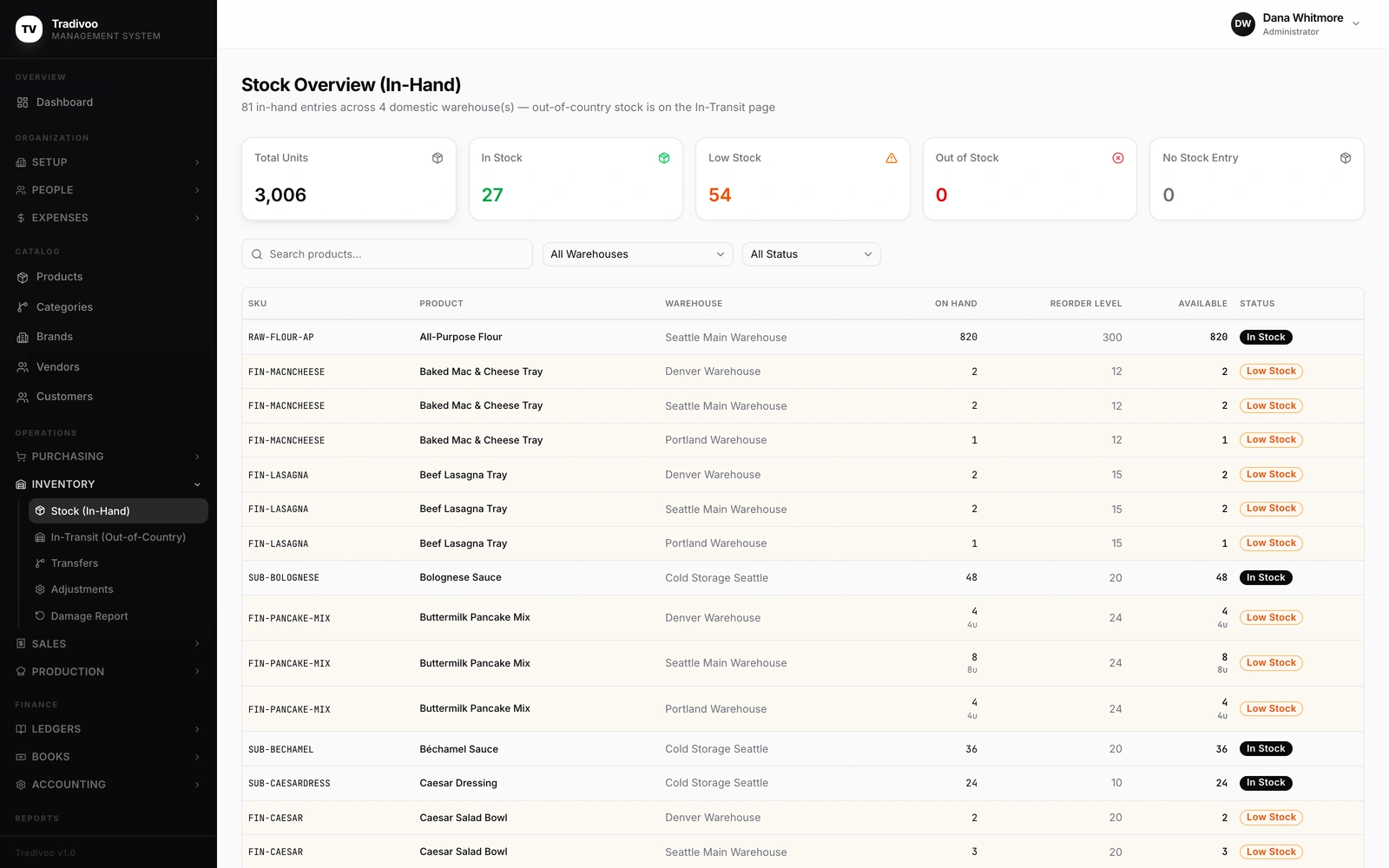
Stock across every warehouse, with reorder levels that flag themselves

Tradivoo's stock overview shows on-hand, reorder level and available units for every SKU in every warehouse, with in-transit stock kept on its own page. Low-stock lines surface on their own, transfers and adjustments are logged, and the same numbers feed purchasing and the books.

  • On-hand, reorder level and available units per SKU and warehouse
  • Low stock and out of stock flagged automatically
  • Transfers, adjustments and damage reports with an audit trail
app.tradivoo.com/inventory/stock
Tradivoo stock overview across warehouses with reorder levels and status

What we build and deliver

Intelligent automation across the work that drains your team.

Document Processing

Read, extract, classify, and route invoices, forms, and contracts with AI accuracy.

Workflow Orchestration

Multi-step processes automated across systems, with branching, approvals, and exceptions.

System Integration & Data Sync

Connections between your tools so data flows automatically instead of by copy-paste, with reliable movement and reconciliation of data between systems.

AI Agents

Agents that take on multi-step tasks where the next step depends on judgment.

Monitoring & Control

Dashboards and alerting that keep automation accountable and under control.

Use cases

Where it creates value

Automation that pays for itself across the back office.

Finance

Invoice & AP automation

Read, match, and route invoices automatically. Processing time comes down, and so does the error rate that manual matching carries.

Operations

Data entry elimination

Move information between systems automatically instead of by hand.

HR

Onboarding workflows

Bringing someone on touches documents, accounts, and approvals. Every one of those steps is routine, and every one of them waits on a person. Automation runs the sequence instead.

Insurance

Claims & intake

Process claims and applications faster with intelligent document handling.

Legal

Contract processing

Extract, route, and track contract data automatically.

Customer Ops

Request handling

Triage routine customer requests as they arrive. The ones that follow a known pattern get fulfilled without a manual touch.

Business outcomes

The return on the work

The return on automating the right work.

70%
Manual work removedHours of repetitive work eliminated, freeing people for higher-value tasks.
90%
Fewer errorsSoftware doesn't get tired. Accuracy goes up as manual effort goes down.
5×
Faster throughputProcesses that ran in hours or days complete in minutes.
Flat
Cost to scaleVolume grows without headcount growing alongside it.
How we deliver

How the work actually runs

We map, automate, and monitor, designing for exceptions from the start.

  1. Discovery

    We start by understanding the business, not the brief. Workshops with your team map goals, constraints, data, and the metrics success will be measured against, before anyone writes a line of code.

  2. Planning & Architecture

    We translate the problem into a system: data flows, model choices, interfaces, integrations, and a delivery plan broken into milestones you can evaluate at each step.

  3. Design

    Experience and technical design happen together. We prototype the critical flows early so stakeholders can react to something real instead of a slide deck.

  4. Development

    Senior engineers build in tight, two-week iterations. Every increment is reviewed, tested, and demoed, so progress is visible and course-corrections are cheap.

  5. Testing & QA

    Automated tests, security reviews, performance profiling, and human QA run continuously, not as an afterthought. We ship when it's genuinely ready.

  6. Deployment

    We harden infrastructure, set up CI/CD, observability, and rollback safety, then ship to production with a launch plan that protects uptime and data.

  7. Support & Scale

    After launch we monitor, optimize, and evolve. As usage grows, the architecture grows with it, and the same team that built it keeps it healthy.

The stack we build on

AI & Document

OpenAIAnthropicAzure Document AIOCRLangChain

Orchestration

PythonTemporalAirflown8nZapier

Integration

REST / GraphQL APIsWebhooksPostgreSQLRedis

Infrastructure

AWSGCPDockerGrafana

Industry coverage

FinanceInsuranceHealthcareLegalLogisticsManufacturingRetail
FAQ

Questions we get before we start

Still unresolved? A 30-minute conversation with an engineer usually settles it faster than another page of copy.

Traditional RPA automates rigid, rule-based tasks, clicking through systems and moving structured data on fixed rules. It breaks on exceptions and unstructured inputs. AI automation adds understanding: language models can read messy documents, make judgment-based decisions, and handle the exceptions that defeated RPA. We use the right tool, often a combination, for each part of a process.

We start by mapping your processes honestly. Good automation candidates are high-volume, repetitive, and rules-based or pattern-based. We identify those, estimate the return, and are candid about what shouldn't be automated. We're aiming at impact, never at automation for its own sake.

We design for them from the start. Automation handles the common path, and genuine exceptions route to a human with context. This is the difference between automation that's trusted and automation that's abandoned. Earlier attempts usually failed by pretending exceptions didn't exist.

Yes. Most automation is about making your existing systems work together: moving data and triggering actions across the tools you already use, via their APIs and integrations.

We build automation like production software: monitored, observable, and accountable, with alerting when something needs attention. An automation that fails silently is worse than the manual process, so visibility is a core requirement from day one.

It replaces the repetitive work, not the people. Teams that automate typically redirect talent to higher-value work, such as judgment, relationships, and decisions, rather than shrinking. The point is to stop wasting skilled time on unskilled tasks.

A focused automation for a high-volume process can be live in a matter of weeks and start returning hours immediately. We prioritize the highest-impact processes first.

With privacy and security built in: access controls, encryption, audit logging, and on-premise or private-cloud deployment where regulations require it.

Now taking new projects

Give your team their hours back.

Tell us what's eating your team's time. We'll show you what AI automation can take off their plate.