AI Development

Production AI that survives contact with reality

Most AI projects die in the gap between a promising demo and a dependable system. We're the engineering team that closes it, building custom models, generative AI, and intelligent automation that hold up under real users, real data, and real load.

OverviewAI · AI Development

AI that's an engineering discipline, not a science experiment

Artificial intelligence has crossed a threshold. What was research three years ago is now a competitive baseline, and the companies pulling ahead are not the ones with the flashiest demos, but the ones who have learned to ship AI as a reliable, governed, observable part of their product. That last mile is exactly where most teams stall, and exactly where Villaex does its best work.

AI development is the practice of designing, building, training, deploying, and operating systems that learn from data and make or assist decisions. In practice it spans a wide surface area: classical machine learning for prediction and classification, deep learning for vision and language, generative models for content and reasoning, and the data and infrastructure engineering that makes any of it trustworthy. Done well, it compresses work that used to take teams of people into seconds, surfaces patterns no human could see, and turns static software into systems that improve as they're used.

Businesses need AI now for reasons that have nothing to do with hype. Customer expectations have reset around instant, personalized, intelligent experiences. Operating costs are under pressure, and automation is the most direct lever. Competitors are already encoding institutional knowledge into models that compound over time. The question for most leadership teams is no longer whether to invest in AI, but how to do it without burning eighteen months and a seven-figure budget on a prototype that never makes it to customers.

That's the problem Villaex was built to solve. We bring the operator's discipline of a product company (we run our own AI platforms in production) to every client engagement. We don't chase benchmarks; we chase outcomes that show up in your metrics. We treat models as software: versioned, tested, monitored, and accountable. And we stay through scale, because an AI system that works on launch day and degrades quietly three months later is worse than no AI at all.

PipelineAI

From input to outcome

What an AI engagement actually moves through, stage by stage, and what has to be true at each boundary before the next stage can run.

Source data

Documents, events and system records are collected, cleaned and labelled.

In
Your systems
Out
Prepared corpus

Model & retrieval

Models are tuned and grounded in that corpus so answers trace to a source.

In
Prepared corpus
Out
Grounded output

Evaluation & guardrails

Automated evals, safety checks and human review where stakes demand it.

In
Grounded output
Out
Verified output

Production system

Served behind an API with monitoring, cost ceilings and a rollback path.

In
Verified output
Out
Decisions in product

Feedback edge

Production outcomes re-enter the evaluation set and the next round of tuning.

Where this work usually breaks down

The reasons AI initiatives fail are remarkably consistent across industries. We've seen all of them, and fixed all of them.

Stuck at proof-of-concept

A notebook that works on curated data is a fraction of the work. The jump to a system that handles messy inputs, edge cases, latency budgets, and failure modes is where most projects quietly stop.

Untrustworthy outputs

Models that hallucinate, drift, or behave unpredictably erode user trust fast. Without evaluation, guardrails, and monitoring, one bad output can undo months of goodwill.

Data that isn't ready

AI is only as good as the data feeding it. Fragmented, unlabeled, or poor-quality data is the silent killer of most initiatives, and it rarely shows up in the original estimate.

No path to scale

Inference that's cheap for ten users can be ruinous for ten thousand. Architectures that ignore cost, caching, and throughput collapse under real adoption.

Compliance and risk exposure

Regulated industries can't ship black boxes. Without audit trails, access controls, and human-in-the-loop design, AI becomes a liability instead of an asset.

Talent that comes and goes

Hiring senior ML engineers is hard and slow. Projects staffed with rotating contractors lose context, and context is most of the value.

Our approach

We engineer around every one of those failure modes deliberately. It's the difference between an AI demo and an AI product.

A production-first methodology

We design for deployment from the first sprint. Latency budgets, fallback behavior, cost ceilings, and observability are requirements, written into the architecture alongside the features.

Rigorous evaluation & guardrails

Every model ships with an evaluation harness, automated regression checks, content and safety guardrails, and human-review workflows where stakes demand them.

Data engineering done right

We build the pipelines, labeling workflows, and feature stores that make your data dependable, and we're honest about data readiness before promising outcomes.

Cost-aware architecture

Caching, batching, model routing, and right-sized models keep inference economics sane as you scale from hundreds to millions of requests.

Governance by design

Audit logging, role-based access, PII handling, and explainability are part of the architecture, so regulated industries can adopt with confidence.

A dedicated, senior team

The same experienced engineers from kickoff to scale, so your institutional AI knowledge stays in the building.

Selected Work

Proof, in production

Real systems, shipped and running: the interface, the data model, and the workflows they replaced.

AI Recruiting · Talent Teams

Candidates ranked against the job description, with the evidence attached

Nexa Recruiter reads every CV, parses it into a structured profile and ranks candidates against the job description. Each match shows matched and missing skills, the reasons to talk to the person, the concerns to probe, and a recruiter's take written by the model, so a shortlist takes minutes instead of an afternoon.

  • CV parsing into experience, skills, education and contact fields
  • Ranked matches with matched and missing skills per candidate
  • Reasons to talk, concerns to probe and a written recruiter's take
app.nexarecruiter.com/jobs/senior-full-stack/matches
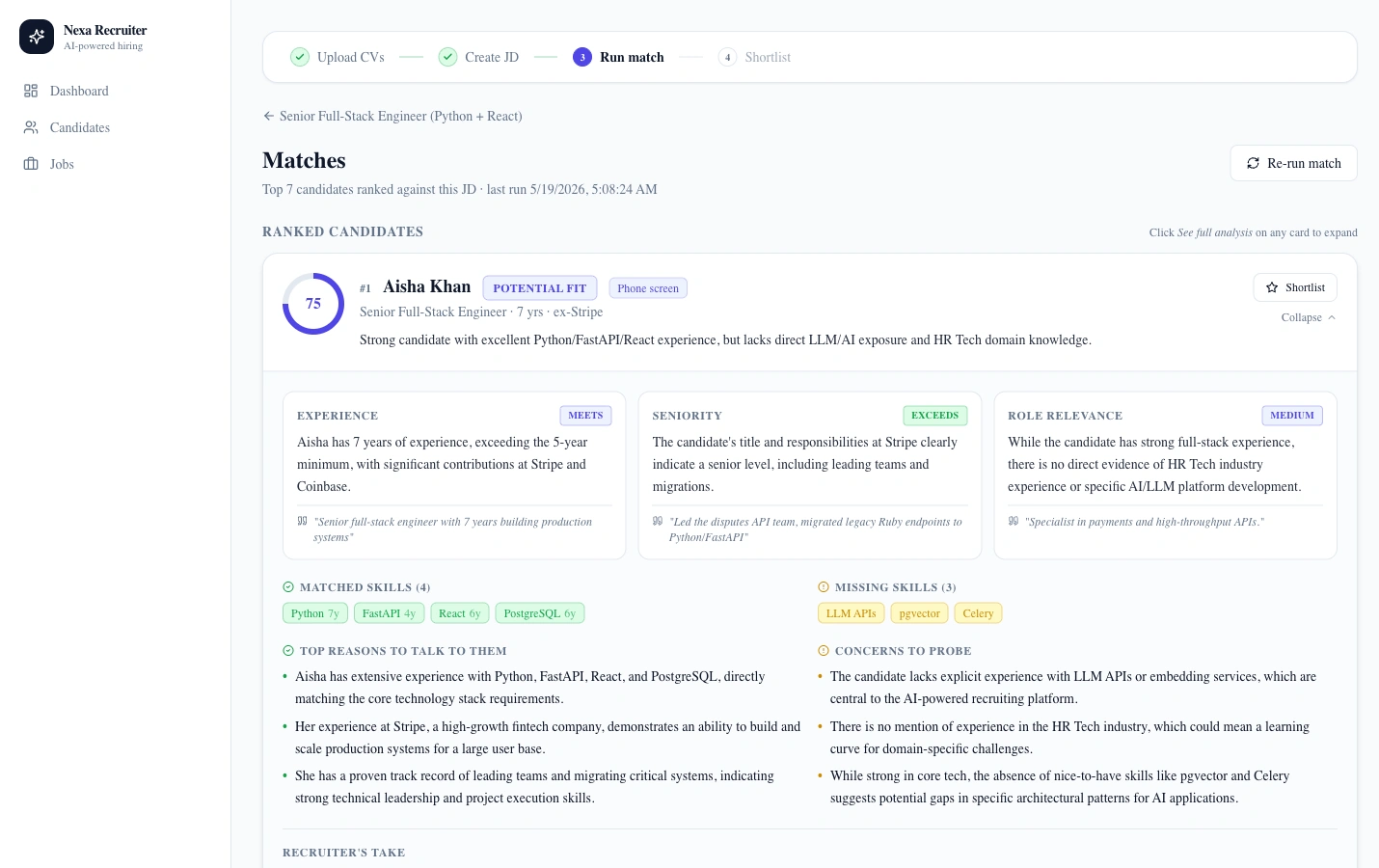
Nexa Recruiter ranked candidate matches with evidence
Call Intelligence · Sales Teams

Every sales call scored, graded and coached the moment it ends

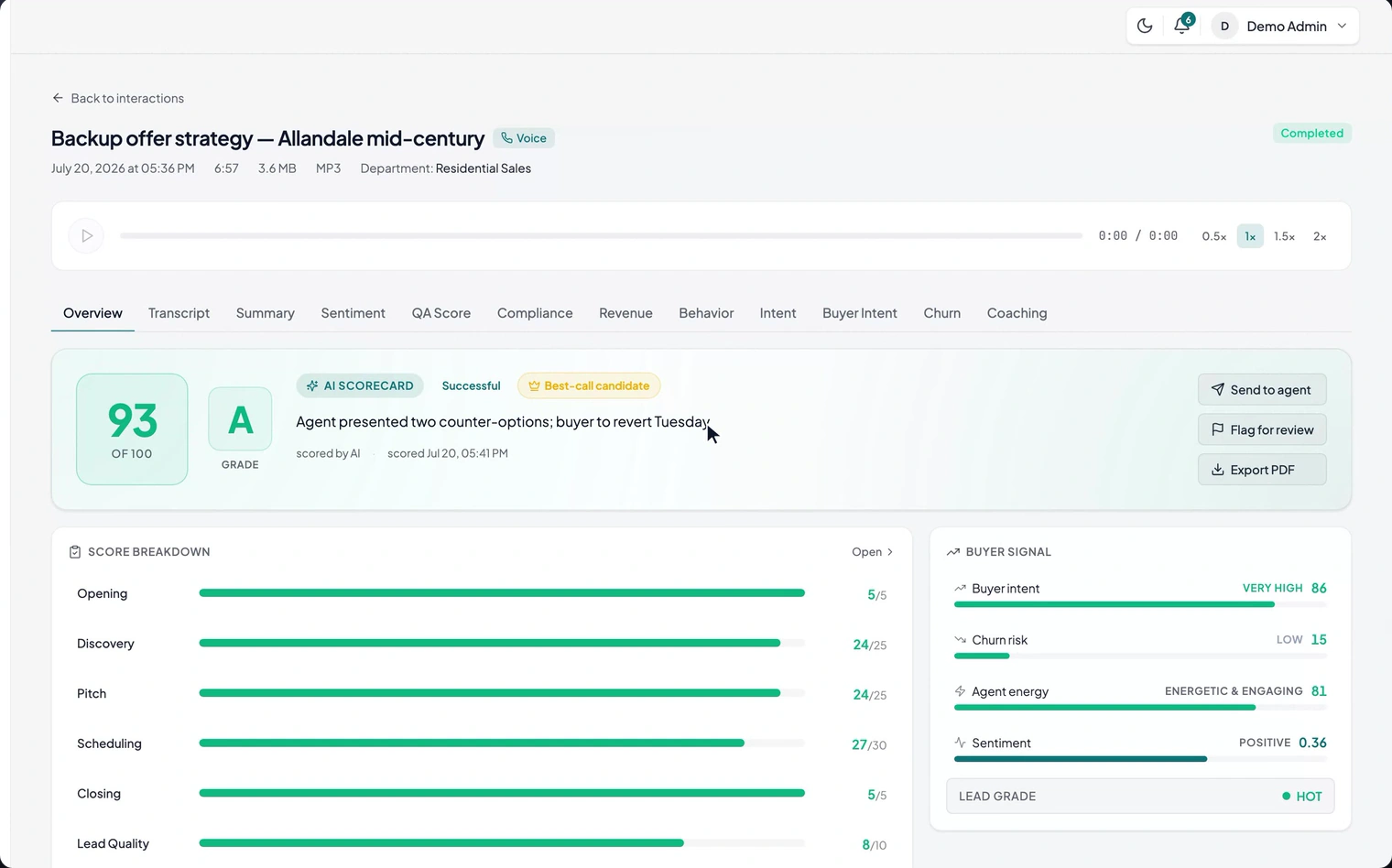
Voxalytics is our call intelligence platform. It pulls recorded calls from telephony systems and CRMs, transcribes and separates speakers, then scores each conversation against a QA rubric, reads buyer intent, churn risk and sentiment, and turns the findings into a coaching playbook the rep can act on the same day.

  • Automatic transcription with speaker separation and timestamps
  • AI scorecard across opening, discovery, pitch, scheduling and closing
  • Buyer intent, churn risk and sentiment surfaced on every call
app.voxalytics.com/calls/allandale-backup-offer
Voxalytics call overview with AI scorecard, score breakdown and buyer signal

What we build and deliver

A complete AI capability under one roof, from the model to the infrastructure that runs it.

Generative AI & LLMs

Copilots, content generation, summarization, and reasoning systems built on OpenAI, Anthropic, and open models, tuned to your domain and guarded against misuse.

RAG & Knowledge Systems

Retrieval-augmented generation that grounds AI in your own data, so answers are accurate, current, and traceable to a source.

AI Agents & Automation

Autonomous and human-in-the-loop agents that execute multi-step workflows, call tools, and take real action across your systems.

Computer Vision

Detection, classification, OCR, and visual inspection systems that turn images and video into structured, actionable data.

NLP & Language

Classification, extraction, sentiment, and translation pipelines that make unstructured text searchable and decision-ready.

MLOps & Delivery

Training pipelines, model registries, and CI/CD for models, so a new version ships the way any other change does.

Monitoring & Drift

Monitoring of live models for accuracy and drift, so systems stay accountable over time.

Use cases

Where it creates value

The same capabilities map to very different outcomes depending on where you point them.

Healthcare

Clinical documentation & triage

Ambient scribing and intake summarization cut the documentation load. Prior-authorization automation removes another block of it. Clinicians get hours back per week.

Financial Services

Risk, fraud & advisory

Real-time fraud detection, and document intelligence for underwriting. For the people working above both, compliant AI copilots for advisors and analysts.

Retail & E-commerce

Personalization

Recommendation engines and visual search that lift conversion.

Retail & E-commerce

Support deflection

AI support agents that take ticket volume off the queue.

Manufacturing

Vision & predictive maintenance

Defect detection on the line, and failure prediction from sensor data. Both cut downtime and waste.

Legal & Professional

Document intelligence

Contract analysis, clause extraction, and research copilots that compress days of review into minutes.

SaaS

Product intelligence

In-product copilots and smart search. The AI features that become the differentiator your roadmap has been missing.

Business outcomes

The return on the work

What it actually changes for the business once the system is live.

60–100×
Throughput on repetitive workTasks measured in hours collapse to seconds, freeing your people for work that needs judgment. Automating that high-volume, rules-heavy work takes 30–50% out of operational cost without removing quality.
24/7
Always-on capabilityAI systems don't sleep, queue, or take vacation. Capacity scales with demand instantly.
Days → minutes
Faster decisionsInsights that once required analysts and meetings surface in real time, where the work happens.
How we deliver

How the work actually runs

A delivery model designed to de-risk AI: working software and honest evaluation at every step.

  1. Discovery

    We start by understanding the business, not the brief. Workshops with your team map goals, constraints, data, and the metrics success will be measured against, before anyone writes a line of code.

  2. Planning & Architecture

    We translate the problem into a system: data flows, model choices, interfaces, integrations, and a delivery plan broken into milestones you can evaluate at each step.

  3. Design

    Experience and technical design happen together. We prototype the critical flows early so stakeholders can react to something real instead of a slide deck.

  4. Development

    Senior engineers build in tight, two-week iterations. Every increment is reviewed, tested, and demoed, so progress is visible and course-corrections are cheap.

  5. Testing & QA

    Automated tests, security reviews, performance profiling, and human QA run continuously, not as an afterthought. We ship when it's genuinely ready.

  6. Deployment

    We harden infrastructure, set up CI/CD, observability, and rollback safety, then ship to production with a launch plan that protects uptime and data.

  7. Support & Scale

    After launch we monitor, optimize, and evolve. As usage grows, the architecture grows with it, and the same team that built it keeps it healthy.

The stack we build on

Models & Frameworks

OpenAIAnthropicPyTorchTensorFlowHugging FaceLangChainLlamaIndex

Data & Vectors

PostgreSQLpgvectorPineconeRedisSnowflakedbtAirflow

Infrastructure

AWSAzureGCPDockerKubernetesTerraformRay

MLOps

MLflowWeights & BiasesBentoMLPrometheusGrafana

Industry coverage

HealthcareFinanceRetailManufacturingLogisticsLegalEducationSaaS
FAQ

Questions we get before we start

Still unresolved? A 30-minute conversation with an engineer usually settles it faster than another page of copy.

Traditional software is deterministic: given an input, it produces a defined output. AI systems are probabilistic; they learn patterns from data and produce outputs with a degree of uncertainty. That changes everything about how you build, test, and operate them. You need evaluation harnesses instead of just unit tests, monitoring for drift instead of just uptime, and human oversight where stakes are high. We bring software engineering discipline to that probabilistic world.

Yes, it's our core strength. We start by assessing what you have, then re-architect for reliability, security, cost, and scale. In most cases the model is the easy part; the work is in the data pipelines, evaluation, guardrails, and infrastructure that make it dependable.

Not always. Modern foundation models and retrieval-augmented approaches let you build powerful systems with modest proprietary data. During discovery we assess your data readiness honestly and recommend the approach that fits: sometimes that's fine-tuning, often it's RAG, occasionally it's a classical model that's cheaper and more explainable.

Through layered defenses: grounding answers in your data with retrieval, constraining outputs with structured generation, validating with automated evaluation, adding guardrails for safety and policy, and routing high-stakes decisions through human review. No single technique is enough; reliability comes from the system around the model.

We work across healthcare, financial services, retail, manufacturing, logistics, legal, education, and SaaS. For regulated industries we design for compliance from the start, with audit trails, access controls, PII handling, and explainability.

A focused proof-of-value usually takes four to eight weeks; a production system, three to six months depending on scope and integration complexity. We work in two-week iterations with demos throughout, so you see progress continuously and can adjust direction early.

Most engagements are scoped per project or run as a monthly dedicated team. We recommend the model that fits your goals during discovery, and we always propose a fixed-scope first phase so you can evaluate the work before committing further.

Yes. You own the code, the models we build for you, and the data. We hand over documentation and run knowledge-transfer sessions so your team can operate and extend the system independently.

Privacy-first by default. We support on-premise and private-cloud deployment, encrypt data in transit and at rest, implement role-based access, and align to SOC 2, GDPR, CCPA, and HIPAA practices depending on your requirements.

Yes. We build against your CRMs, ERPs, data warehouses, and internal APIs so AI augments the tools your teams already use instead of becoming another silo.

Now taking new projects

Let's get your AI to production.

Bring us a stalled prototype or a blank page. We'll come back with a clear plan, a timeline, and the senior team to make it real.