Enterprise Integrations

Make your systems behave as one

Your business runs on a dozen systems that don't talk to each other. We connect your CRMs, ERPs, warehouses, and APIs into one coherent, reliable, real-time whole, so data flows automatically and your teams stop reconciling by hand.

OverviewCloud & Data · Enterprise Integrations

The cost of disconnected systems is hiding in plain sight

Every established business accumulates systems: a CRM here, an ERP there, a warehouse, a billing platform, a support tool, a marketing stack, and a dozen smaller apps. Each was bought to solve a problem, and each does. But none of them talk to the others properly, and the cost of that silence is enormous and largely invisible: data entered three times, reports that never quite agree, customers who have to repeat themselves, and teams burning hours reconciling spreadsheets to make systems that should cooperate appear to. Integration is the work of making them genuinely cooperate.

Enterprise integration is the discipline of connecting separate systems so they share data and trigger actions reliably, turning a collection of silos into a coherent whole. It spans the APIs and connectors that move data between systems, the orchestration that coordinates multi-system processes, the transformation that reconciles different data formats and meanings, the real-time eventing that keeps everything current, and the monitoring that keeps it all trustworthy. Done well, it makes the organization's systems behave as one, so data is entered once and available everywhere, accurate and current.

The need grows with every system added. The more tools a business runs, the more the gaps between them cost in manual effort, in errors, and in decisions made on data that's stale or wrong because it lived in the wrong place. AI and automation raise the stakes further: they're only as good as the data they can reach, and disconnected systems starve them. The companies that integrate well move faster and decide better; those that don't accumulate a quiet tax on everything they do.

Villaex builds integrations that are reliable enough to depend on. We map the systems and the data that needs to flow between them, build connections that are resilient to the failures real integrations face, reconcile the format and meaning mismatches that derail naive attempts, and monitor everything so problems surface instead of corrupting data silently. The outcome is a business where your systems cooperate: one source of truth, automatic data flow, and the foundation that automation and AI require.

PipelineCloud & Data

From input to outcome

How scattered systems become one governed source of truth, and what each layer guarantees to the layer above it.

Sources

Databases, APIs, SaaS tools and event streams, connected once and documented.

In
Every system
Out
Raw extracts

Pipelines

Automated ingestion with retries, alerting and freshness monitoring.

In
Raw extracts
Out
Landed data

Warehouse & models

Tested, version-controlled transformations into governed, documented tables.

In
Landed data
Out
Trusted tables

Analytics & AI

Dashboards, self-serve analytics and the feature sets models train on.

In
Trusted tables
Out
Decisions & models

Feedback edge

Quality tests and lineage checks report failures back to the pipeline layer.

Where this work usually breaks down

The hidden tax of disconnected systems shows up everywhere.

Double and triple entry

The same data keyed into multiple systems by hand, wasting time and breeding errors.

Reports that disagree

Numbers that differ by system because data lives in silos and is never reconciled.

Stale data, bad decisions

Decisions made on information that's out of date because it didn't flow to where it was needed.

Brittle point-to-point hacks

Fragile one-off scripts connecting systems that break whenever anything changes.

Customers repeating themselves

Disjointed systems that make customers re-supply information you already have.

Starved automation and AI

Automation and AI initiatives blocked because the data they need is trapped in disconnected tools.

Our approach

We connect systems to be reliable, real-time, and maintainable.

API & connector integration

Robust connections between your systems via their APIs, built to be resilient and maintainable.

Process orchestration

Coordinating multi-system workflows so end-to-end processes run automatically.

Data transformation

Reconciling the format and meaning differences between systems so data flows correctly.

Real-time eventing

Event-driven architecture that keeps systems current instead of relying on laggy batch jobs.

Resilience & error handling

Retries, idempotency, and failure handling that keep integrations dependable in the real world.

Monitoring & lineage

Visibility and audit trails so data flow is trustworthy and problems surface immediately.

Selected Work

Proof, in production

Real systems, shipped and running: the interface, the data model, and the workflows they replaced.

Payroll · HR Operations

Payroll computed from real attendance, approved in one pass

Nexa People runs payroll from the same attendance and leave data the rest of the platform uses. Each pay run shows gross, tax, attendance adjustments and net pay per employee with a breakdown, then moves through approval and disbursement with an audit trail.

  • Gross, tax and net pay computed from attendance and leave
  • Approval, payslip sign-off and disbursement in one flow
  • Salary advances, claims and adjustments handled in the same module
app.nexapeople.com/payroll/run
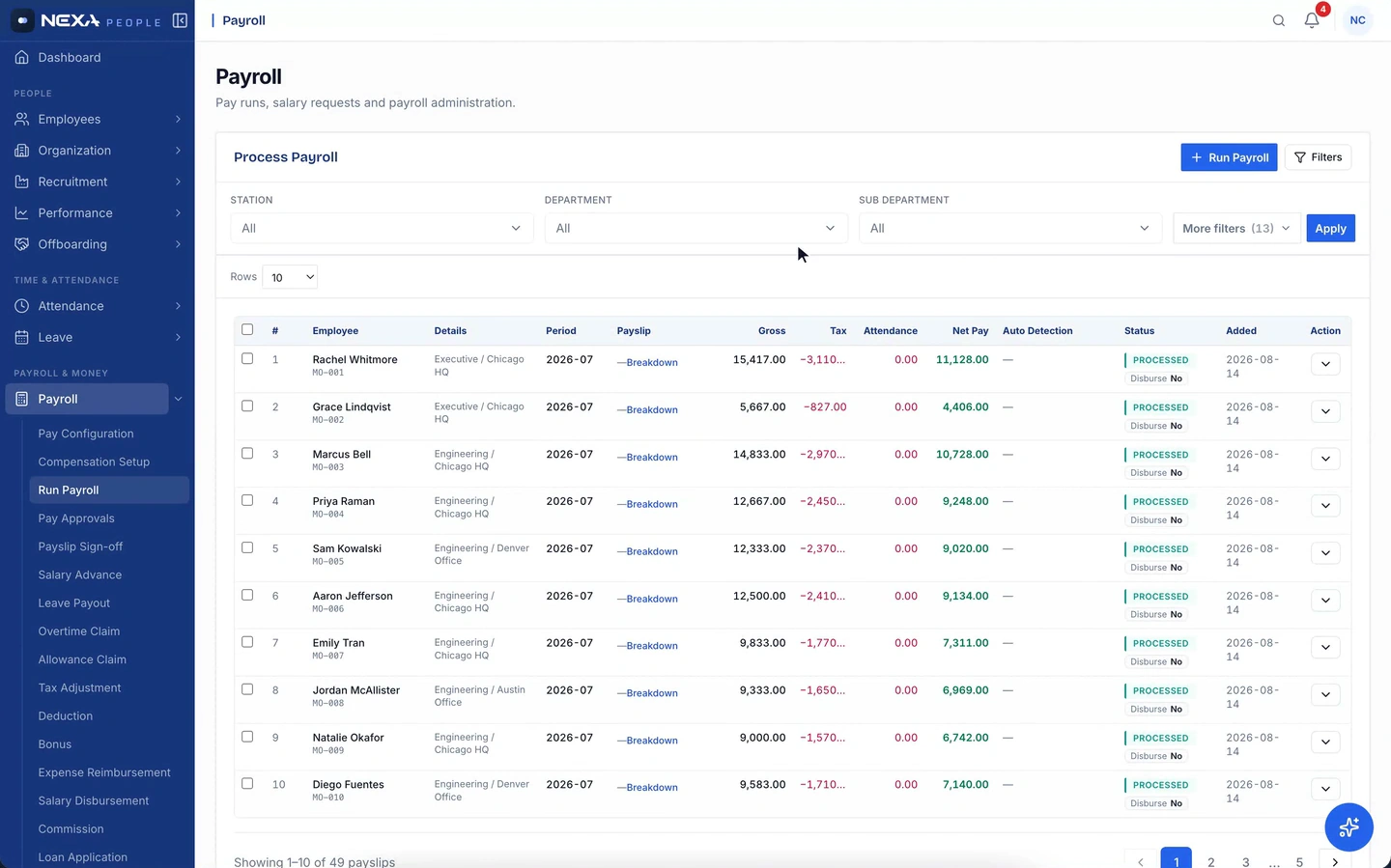
Nexa People payroll run with gross, tax and net pay per employee
Unified Data Platform · Retail

From conflicting reports to one source of truth

Sales, inventory, and customer data lived in systems that never agreed, and a planned AI project was blocked because the data wasn't usable. We built a unified platform with automated pipelines into a modeled warehouse, tested transformations, real-time dashboards, and governance. It became the foundation for everything next.

  • Automated pipelines from every system into one warehouse
  • Tested, version-controlled transformations and lineage
  • Real-time dashboards the whole org could trust
quantvue.io/explore/revenue-by-region
ExploresRevenue by region

Net revenue by region

Weekly · USD · 12 Dec 2025 to 12 Mar 2026

WestMidwestNortheast
$120k$90k$60k$30k$0
W10 · West $118.4k
Dec 15Jan 05Jan 26Feb 16Mar 09
RegionOrdersNet revenueΔ prior
West18,402$1,284,910+12.4%
Midwest12,865$842,377+6.1%
Northeast9,143$611,204−2.8%
South7,690$498,552+3.7%
Mountain5,218$342,088+1.2%

What we build and deliver

The full integration toolkit, built for reliability.

System Integration

Connecting CRMs, ERPs, warehouses, and apps so they share data and trigger actions, with purpose-built APIs and middleware where off-the-shelf connectors fall short.

Process Orchestration

Coordinating multi-system workflows into reliable, automated end-to-end processes.

Data Sync & Migration

Reliable, monitored data movement, reconciliation, and one-time migrations.

Real-Time Eventing

Event-driven integration that keeps systems current as things happen.

Monitoring & Governance

Observability, lineage, and alerting that keep integrated data trustworthy.

Use cases

Where it creates value

Integration that pays back across the business.

Sales & Customer Ops

CRM and the customer record

Connecting CRM to marketing, support, and billing. The result is a unified customer view. One coherent customer record, across every system that touches them.

Operations

ERP integration

Linking ERP to the systems around it so operations run on one coherent data flow.

Finance

Billing & finance sync

Billing, accounting, and reporting connected to each other. Financials come out accurate and automatic.

Data Teams

Warehouse integration

Feeding every system into the warehouse for unified analytics and AI.

Commerce

Commerce stack integration

Connecting storefront, inventory, fulfillment, and support into one flow.

Business outcomes

The return on the work

What connected systems return.

1
Source of truthData entered once and consistent everywhere, ending the reconciliation tax.
90%
Less manual movementData flows automatically instead of being copied between systems by hand.
Real-time
Data freshnessData reaches the systems that need it as events happen, so decisions run on current information.
Ready
For automation & AIThe connected data foundation that automation and AI depend on.
How we deliver

How the work actually runs

Map, connect, and monitor. Built to be resilient and maintainable.

  1. Discovery

    We start by understanding the business, not the brief. Workshops with your team map goals, constraints, data, and the metrics success will be measured against, before anyone writes a line of code.

  2. Planning & Architecture

    We translate the problem into a system: data flows, model choices, interfaces, integrations, and a delivery plan broken into milestones you can evaluate at each step.

  3. Design

    Experience and technical design happen together. We prototype the critical flows early so stakeholders can react to something real instead of a slide deck.

  4. Development

    Senior engineers build in tight, two-week iterations. Every increment is reviewed, tested, and demoed, so progress is visible and course-corrections are cheap.

  5. Testing & QA

    Automated tests, security reviews, performance profiling, and human QA run continuously, not as an afterthought. We ship when it's genuinely ready.

  6. Deployment

    We harden infrastructure, set up CI/CD, observability, and rollback safety, then ship to production with a launch plan that protects uptime and data.

  7. Support & Scale

    After launch we monitor, optimize, and evolve. As usage grows, the architecture grows with it, and the same team that built it keeps it healthy.

The stack we build on

Integration

REST / GraphQL APIsWebhooksiPaaSCustom middleware

Eventing

KafkaKinesisEventBridgeWebhooks

Orchestration

TemporalAirflown8nStep Functions

Data & Ops

PostgreSQLRedisSnowflakeGrafana

Industry coverage

FinanceRetailManufacturingHealthcareLogisticsSaaSInsurance
FAQ

Questions we get before we start

Still unresolved? A 30-minute conversation with an engineer usually settles it faster than another page of copy.

We start by mapping your systems and the data that needs to flow between them, then prioritize the connections with the highest impact, usually the ones causing the most manual work or the worst data discrepancies. You see value from the first integration rather than waiting for a big-bang connect-everything project.

Almost certainly. We integrate via APIs, connectors, webhooks, and custom middleware where needed. If a system has any way to get data in and out, and nearly all do, we can connect it. We'll confirm specifics during discovery.

It depends. Integration platforms (iPaaS) are great for common, well-supported connections and faster setup. Custom integration is better for complex logic, performance-critical flows, or systems an iPaaS doesn't handle well. We recommend, and often combine, based on your situation rather than defaulting to one.

Through resilient design: retries, idempotency, error handling, and graceful degradation for the failures real systems throw, plus monitoring and alerting so problems surface immediately. Brittle point-to-point scripts are exactly what we replace.

Yes. We build event-driven, real-time integration where freshness matters, so systems update as things happen rather than lagging behind a nightly batch.

Significantly. Automation and AI are only as good as the data they can reach, and disconnected systems starve them. Integration is often the unlock that makes those initiatives possible.

That's a core part of the work. We build transformation that reconciles the format and semantic differences between systems, the mismatches that derail naive integrations, so data flows correctly and consistently.

Yes. We build maintainable, documented integrations and run knowledge transfer, so your team can operate and extend them. We can also provide ongoing support.

Now taking new projects

Make your systems cooperate.

Tell us which systems aren't talking. We'll connect them into one coherent, reliable whole.