Logistics

Logistics software and voice agents for the hours when the plan changes

We build order intake, dispatch boards, driver apps, tracking and proof of delivery, and voice agents that answer the calls about where a load is, so coordinators work exceptions instead of working the phone.

The sector

Logistics runs on exceptions, not on plans

A logistics operation is a plan that survives until the first delay. A driver calls in sick, a dock is backed up, a customer moves a delivery window, and the schedule someone spent the morning building has to be rebuilt before the next stop. Everything after that point is exception handling, and it lands on a coordinator with a phone.

A common setup is a dispatch board in a spreadsheet, driver updates arriving by message, and a customer who sees nothing until someone types an email. Every handover between those three is a place where a load goes quiet and a coordinator has to chase it by phone. Before any of that, the booking arrived as an attachment and somebody retyped it.

We build the layer that closes those gaps. Intake that reads the booking, one board that shows every load and driver, an app that keeps working when the phone loses signal, voice agents that answer the calls asking where a load is, and a view of yesterday that shows on time arrivals, dwell and why a drop failed. All of it has to be right at two in the morning.

What makes it hard

The constraints that shape logistics systems

Orders arrive as attachments

Bookings turn up as a PDF, an emailed spreadsheet or a phone call, and someone retypes them into the TMS. A wrong postcode or a misread window becomes a failed drop, and the original request sits in an inbox.

Drivers work with bad signal

Scans, signatures and photos get captured in loading bays and rural lanes where there is no data. If the app needs a connection to record a delivery, the driver stops using it and calls the office instead.

The phone is the bottleneck

The same questions arrive all day. Where is it, when will it arrive, and can you move it. Coordinators answer them one at a time and only reach the real exceptions once the queue clears.

Proof of delivery decides payment

A missing signature or an unreadable photo turns into a claim long after the stop, when nobody remembers it. The capture has to be structured at the door, tied to the load, and hard to skip.

What we build

Systems we ship for logistics teams

Order intake that stops retyping

Intake that reads the booking document or takes the call, pulls out reference, addresses, window and instructions, flags the fields it is unsure about for a human, and writes the load into the system once.

Dispatch and assignment boards

A live board of loads, drivers, subcontracted carriers and vehicles with assignment, reassignment and exception flags. A change reaches the driver app, the customer tracking link and the billing record in the same action, so nothing is retyped.

Driver apps that work offline

Android and iOS apps that queue scans, signatures, photos and status updates on the handset and sync when signal returns. The driver never waits on a spinner, and the office sees the stop the moment the phone reconnects.

Voice agents on the dispatch line

An agent that answers the main line, identifies the load or the account, reads back live status, moves a collection window, and hands the call to a coordinator with the transcript when it becomes an exception.

Integrations with the systems you keep

TMS, WMS, ELD, telematics, accounting and customer portals joined by an integration layer with retries and a visible failure queue, so a dropped webhook becomes a task instead of a load that quietly vanishes.

Proof

Screens from systems in production

dispatch.freightline.co/board

Dispatch board

Thu 12 Mar · 11 active
All lanes
MBDWNO
New load
Unassigned4
LD-88214

Reno NVBoise ID

53' Dry van · 18,400 lb

?Assign driver14:00
LD-88219

Fresno CATucson AZ

53' Reefer · 22,100 lb

?Assign driver16:30
LD-88223

Ogden UTCasper WY

48' Flatbed · 31,800 lb

?Assign driver18:15
LD-88231

Yakima WAEugene OR

53' Reefer · 16,900 lb

?Assign driver21:00
En route4
LD-88190

Denver COOmaha NE

53' Dry van · 26,500 lb

MBMarcus Bell19:40
LD-88186

Salt LakePortland OR

53' Reefer · 19,200 lb

DWDana Whitlock23:05
LD-88178

Amarillo TXWichita KS

48' Flatbed · 28,700 lb

IPIvan Petrov+45m
LD-88174

BakersfieldLas Vegas NV

53' Dry van · 21,300 lb

NONia Okafor17:20
Delivered3
LD-88141

Phoenix AZEl Paso TX

53' Dry van · 24,000 lb

SMSofia Marino06:42
LD-88137

SacramentoReno NV

53' Reefer · 17,300 lb

KAKwame Adjei05:18
LD-88129

Billings MTFargo ND

48' Flatbed · 30,400 lb

ERElena Ruiz04:55
Custom Platform · Logistics

One platform replaced a decade of spreadsheets

A national logistics operator ran dispatch on spreadsheets, phone calls, and a system no one fully understood. We built a custom dispatch-and-tracking platform with real-time assignment, a driver app, live status, and automated customer notifications. It integrates with their accounting, on architecture documented for their own team to extend.
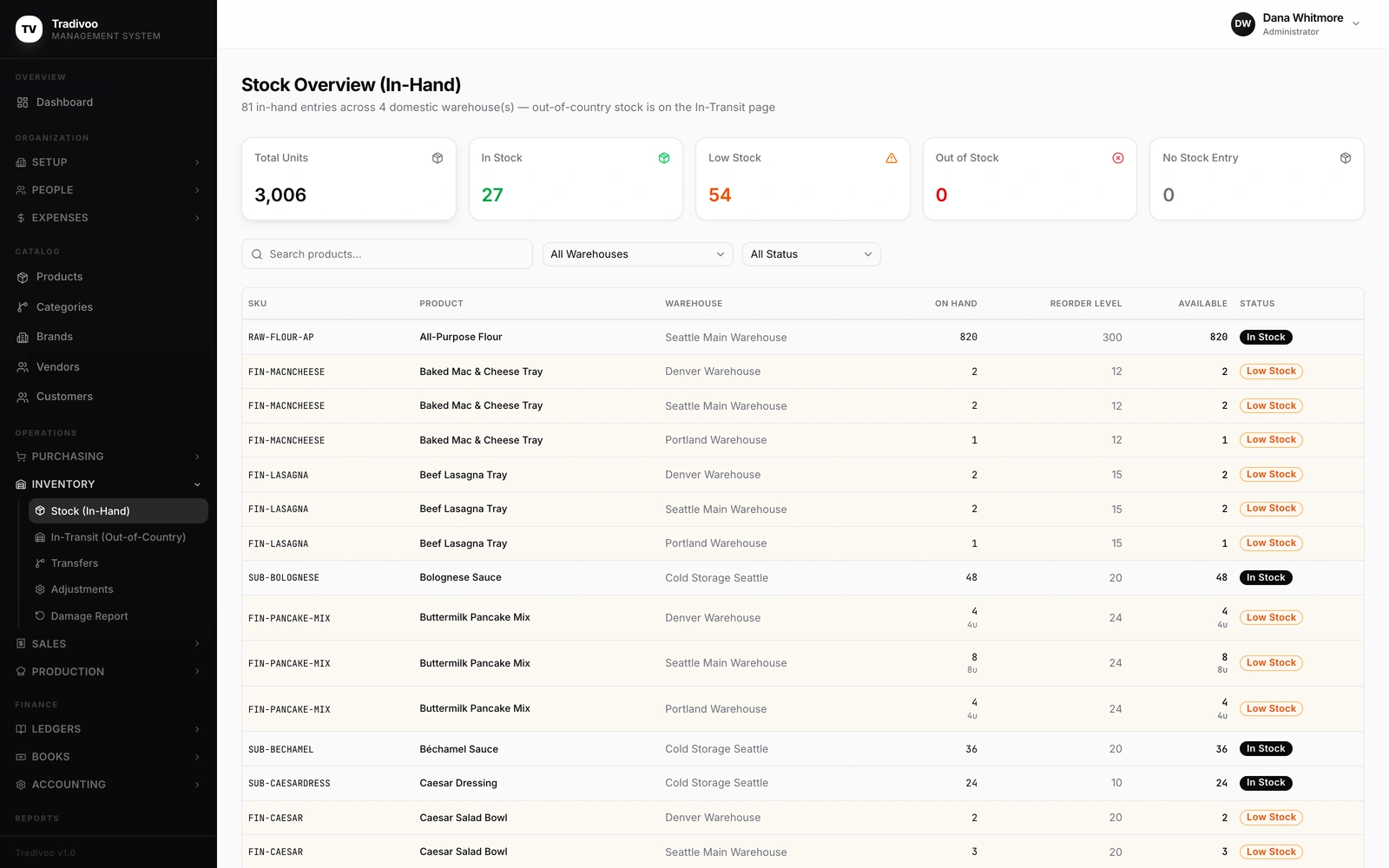
app.tradivoo.com/inventory/stock
Tradivoo stock overview across warehouses with reorder levels and status
Inventory · Trading Operations

Stock across every warehouse, with reorder levels that flag themselves

Tradivoo's stock overview shows on-hand, reorder level and available units for every SKU in every warehouse, with in-transit stock kept on its own page. Low-stock lines surface on their own, transfers and adjustments are logged, and the same numbers feed purchasing and the books.

FAQ

Questions we get before we start

Still unresolved? A 30-minute conversation with an engineer usually settles it faster than another page of copy.

With a short discovery on one lane and one depot, not the whole network. We map how a load moves today, from the booking landing in an inbox to the proof of delivery coming back, and pick the first slice that removes real phone traffic. That slice ships as working software before the rest is scoped. You own the code and the repository from the first commit.

Usually not. A TMS that already handles rating and settlement can stay where it is. We build the dispatch view, the driver app or the customer facing tracking it does not cover, and integrate both ways so the record of truth stays in one place. During cutover the new pieces run alongside the live TMS, on real loads, before anyone is asked to switch.

The app is built offline first. Stops, scans, signatures and photos are written to local storage on the handset and queued for sync, with conflict rules for the case where the office changed the same load in the meantime. Drivers keep working through dead zones and the office sees everything once the phone reconnects.

Location and telematics are personal data about a named driver, so we treat them that way. Access is scoped by role, retention is set to a period you choose rather than kept forever, and the reason each feed exists is written down. If a works council or a union agreement limits tracking, that becomes a rule in the system, not a policy document.

Building something for logistics?

A 30 minute conversation with an engineer is usually enough to scope it honestly.