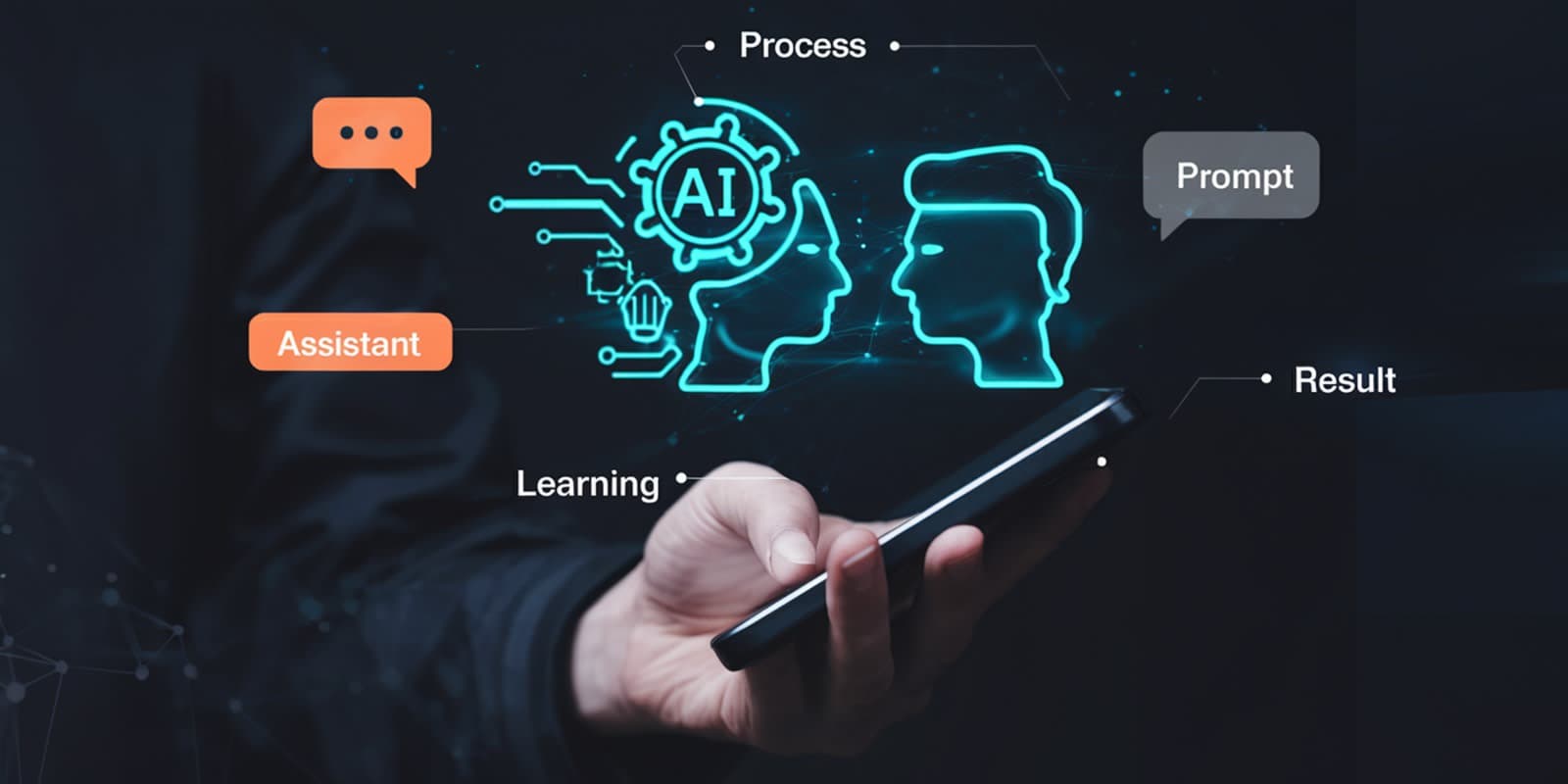
“Hi there! How can I help you today?” Writing that line takes about four seconds. Everything after it is design psychology, data science and natural language understanding, stacked up so that the next reply sounds like it came from someone who was actually listening.
Users stopped being impressed by the greeting a long time ago. The bar now is a bot that understands what was meant, remembers what was said ten minutes back, and can tell when the person on the other end has started to lose patience.
At Villaex Technologies we build AI chatbots with one goal: make automation feel personal. What follows is the working method, covering conversational UX, behavioural psychology and the language models underneath.
Why most chatbots still feel robotic
Plenty of bots built on current NLP return answers that are cold, repetitive or simply confusing, so users give up and the business loses the conversation it paid to start. The causes repeat from project to project. Scripts are rigid and miss nuance. Tone is flat, with no read on the user's emotional state, and the flow was drawn as a straight line, so anything off-script breaks it. There is no memory, which means every message starts from nothing. What you end up with stands between the user and the thing they came to do.
What conversational UX is
Conversational UX is the practice of designing interactions between people and chatbots, voice assistants or any AI-driven conversational interface so that they feel natural to the person on the other end. It borrows from linguistics, because how people actually talk is not how a spec says they should. It borrows from cognitive psychology, because a conversation is processed differently from a page of text. And it borrows from AI and NLP research, which is what lets the machine hold up its half. Done properly, the bot stops being a searchable FAQ and starts working as a representative of the brand. That shows up in customer satisfaction and in repeat business.
Natural language understanding
Human conversation is messy. The NLU models have to catch intent when it arrives in an unexpected shape, handle synonyms, slang and regional phrasing, and pull out the entities that matter: time, location, product. “I'm looking for black sneakers” and “Do you have dark running shoes?” should land on the same smart reply.
Personalization and context memory
The best bots remember your name, your preferences, and what you asked last time. We give bots short-term and long-term memory so that context carries across a multi-step interaction and nobody is asked to repeat themselves. Greetings and product suggestions can then start from something real: “Welcome back, Sarah. Last time you asked about cloud migration. Want to continue where we left off?”
Conversation flow and fallback paths
Instead of a linear script we map a conversation tree with fallback paths at every branch. Users can change subject halfway through and the bot follows, and errors get handled without arriving at a dead end. And when the bot does miss, the recovery line decides what happens next. “Sorry, I don't understand” ends the conversation. “Hmm, I didn't catch that. Did you mean X or Y?” keeps it alive.
Tone, empathy and micro-copy
Words carry the brand, so we write the bot's copy and tune the model until its register matches yours: humour and emoji where the audience expects them, a real apology when something breaks, an acknowledgement when the user has done what was asked. “I'm really sorry your payment failed. Let's fix this together” costs nothing to write and changes how the failure lands.
Voice and multilingual capability
Modern chatbots rarely live on one platform, so ours are trained for voice through speech recognition APIs and for multilingual NLP that adapts tone and cultural register per market. For global e-commerce and customer support, that is the difference between a bot that works in one country and a bot that can ship.
Case study: a fashion e-commerce chatbot
A leading fashion brand came to Villaex Technologies to replace a static live chat widget with a human-like AI chatbot. Ninety days in, cart abandonment had dropped by 18% and conversions were up 27%. Forty percent of customer queries closed without a human touching them, and the CSAT score improved by 32%. What did it was product recommendation algorithms and sentiment detection, wrapped in a warm conversational tone written for their young audience.
Four mistakes to avoid
Good technology still fails on execution. These four account for most of it:
- Ignoring tone and personality. Nobody enjoys talking to a robotic wall of text.
- Not handling edge cases. One confusing answer is enough to lose the user's trust.
- Forgetting the off-ramp. There should always be a route through to a human.
- Over-automating. Know the point where automation should stop and empathy should take over.
Where conversational UX is heading
Emotional AI is the nearest of these, with bots reading tone of voice or emotional state and adjusting accordingly. Multi-modal interfaces are close behind, taking voice, image and text in the same session. Hyper-personalization is pushing down into user psychographics, and memory-driven conversation is making continuity across sessions ordinary rather than remarkable. We are building toward all four.
Building something like this?
Tell us what runs today and where it hurts. An engineer reads it and replies.