MatrixFlow
The site for a Nashville firm that maps how operations teams actually work, then builds the software, data and secure infrastructure underneath.
What they came with
A firm selling four things that are genuinely separable, leadership work, workflow design, engineering and rollout, has to make each one buyable on its own without the site reading as a menu of everything. Most of the delivered proof sits in healthcare, where the work touches PHI and every claim has to carry its own qualification. There is also a product in private beta and a whole client experience that no customer has yet, both of which need showing rather than describing. And one engagement runs the length of a laboratory operation, from a practitioner order to an approved report.
What the build had to do
A working demo, not a screenshot
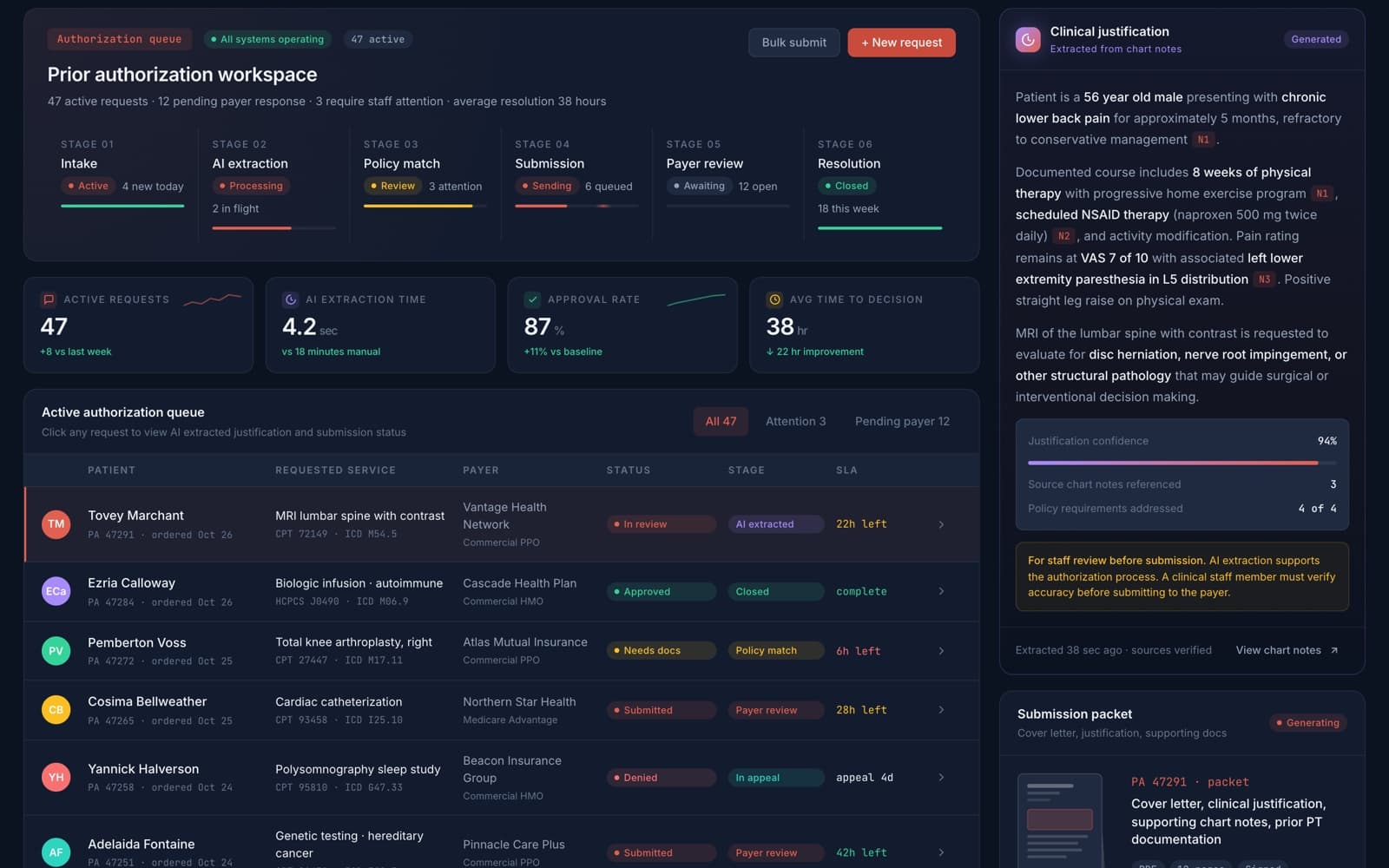
The platform route is a prior authorization workspace built out in full: six pipeline stages with counts, a queue of requests carrying payer, CPT and ICD codes, an extraction panel with a confidence figure and a source count, a packet generator and a signed audit trail. Every record is synthetic, and the page says so in a bar above the fold and again in a closing notice that names each fictitious payer.
A second brand inside the site
The Chestnut Hill route is an entire veterinary practice website, with booking, a pet portal, a team page and a service list, under a different name, palette and typeface from the parent. It has to read as a real practice to make the point, and be labelled clearly enough on the page that links to it that nobody takes it for a live clinic.
Four services that stand alone
The services page states plainly that the technical work can be bought without the leadership consulting, and the leadership work without a technical project. Each of the four groups carries its own availability line and its own deliverable list, so the boundary between them is legible before anyone books a call.
The case study as a lifecycle
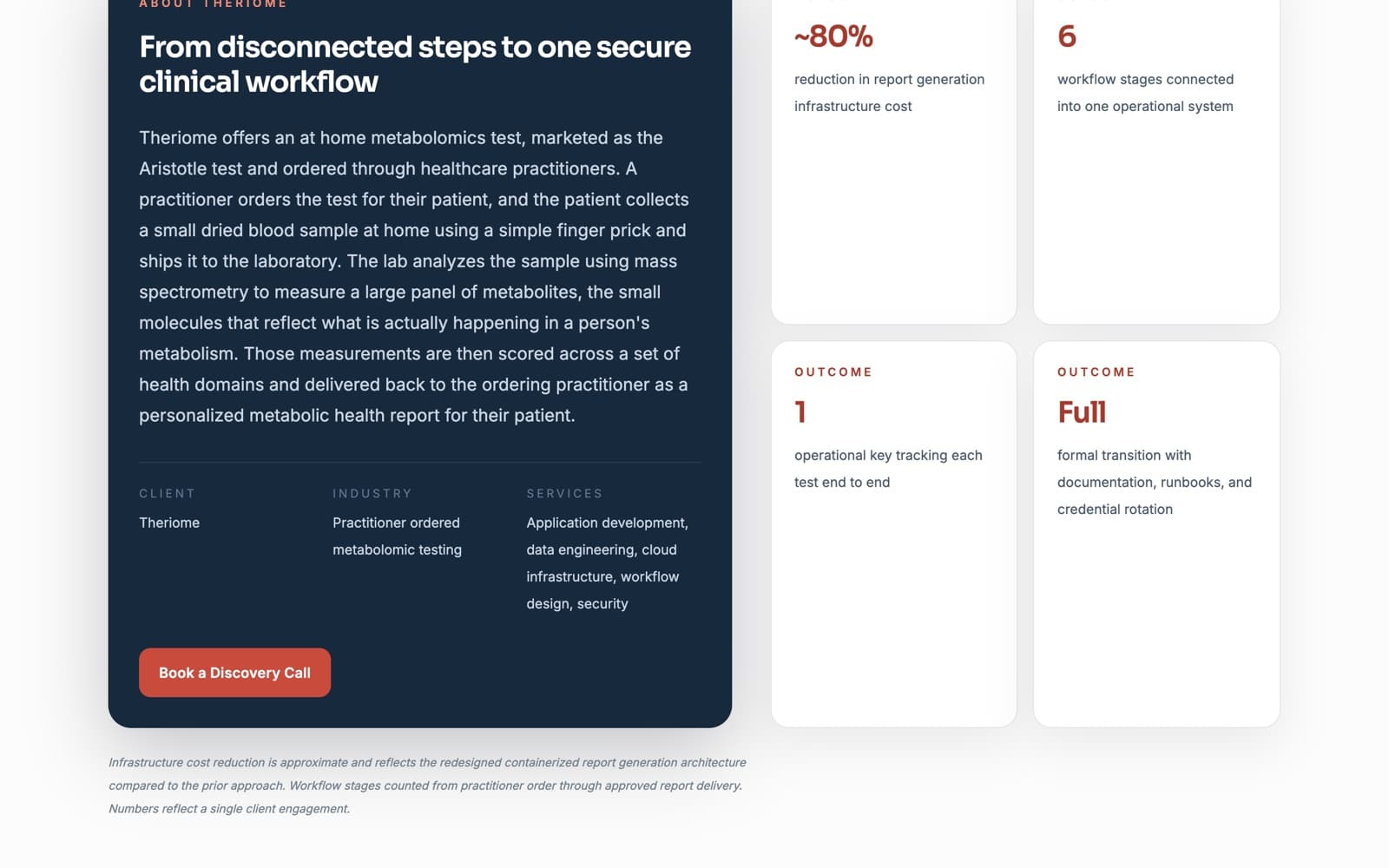
The Theriome page follows a single test through six stages, from practitioner order and intake through kit logistics, laboratory data, report generation, scientific review and delivery, then lists what was built against each. The structure has to hold the operational narrative and the security architecture in one document without splitting into two.
Numbers that carry their footnote
Each outcome tile is paired with a methodology note set under the block: what a percentage is measured against, how the stages were counted, and that the figures come from one engagement. The stat and its qualification are the same component, so a number cannot ship without the sentence that bounds it.
Technical detail
Prerendered routes on a self-hosted runtime
Every route in the sitemap returns x-nextjs-prerender: 1 with x-nextjs-cache: HIT and a 300 second stale time, so the document is static with a short revalidation window and nothing renders on the request path. The vary header lists rsc and the router-state keys, which is what lets in-app navigation fetch a flight payload rather than a fresh document, and the absence of any edge-provider header means the cache is the Next runtime's own.
The clinic demo bypasses the app
The Chestnut Hill page is a standalone HTML file served as a static asset rather than a Next route. It ships its own doctype, its own inlined :root token block, pine, chestnut, brass and ivory with their own radius and shadow scale, and its own Spectral and Mulish faces, with no _next chunks at all. Nothing from the parent design system can reach it, which is the point of isolating a second brand this way, and the cost is that the demo does not share the app's components or its font loading.
Two indexing boundaries and a quiet form
The platform route carries meta robots noindex, nofollow, noarchive, nosnippet, and robots.txt disallows both it and the demo tree, so synthetic clinical data never reaches a search result. The contact form pairs an off-screen honeypot field, aria-hidden with tabindex -1 and autocomplete off, with a printed instruction not to include patient information, which keeps PHI out of the inbox by design rather than by moderation after the fact.
The stack
Framework
Styling
Content and SEO
Delivery
- Sector
- Healthcare workflow engineering
- Audience
- Clinics, labs, operations leaders
- Shape
- Services, case studies, demos
- Platform
- Next.js, self-hosted
Something like this to build?
Tell us what runs today and where it hurts. An engineer reads it and replies.