Bay Path University
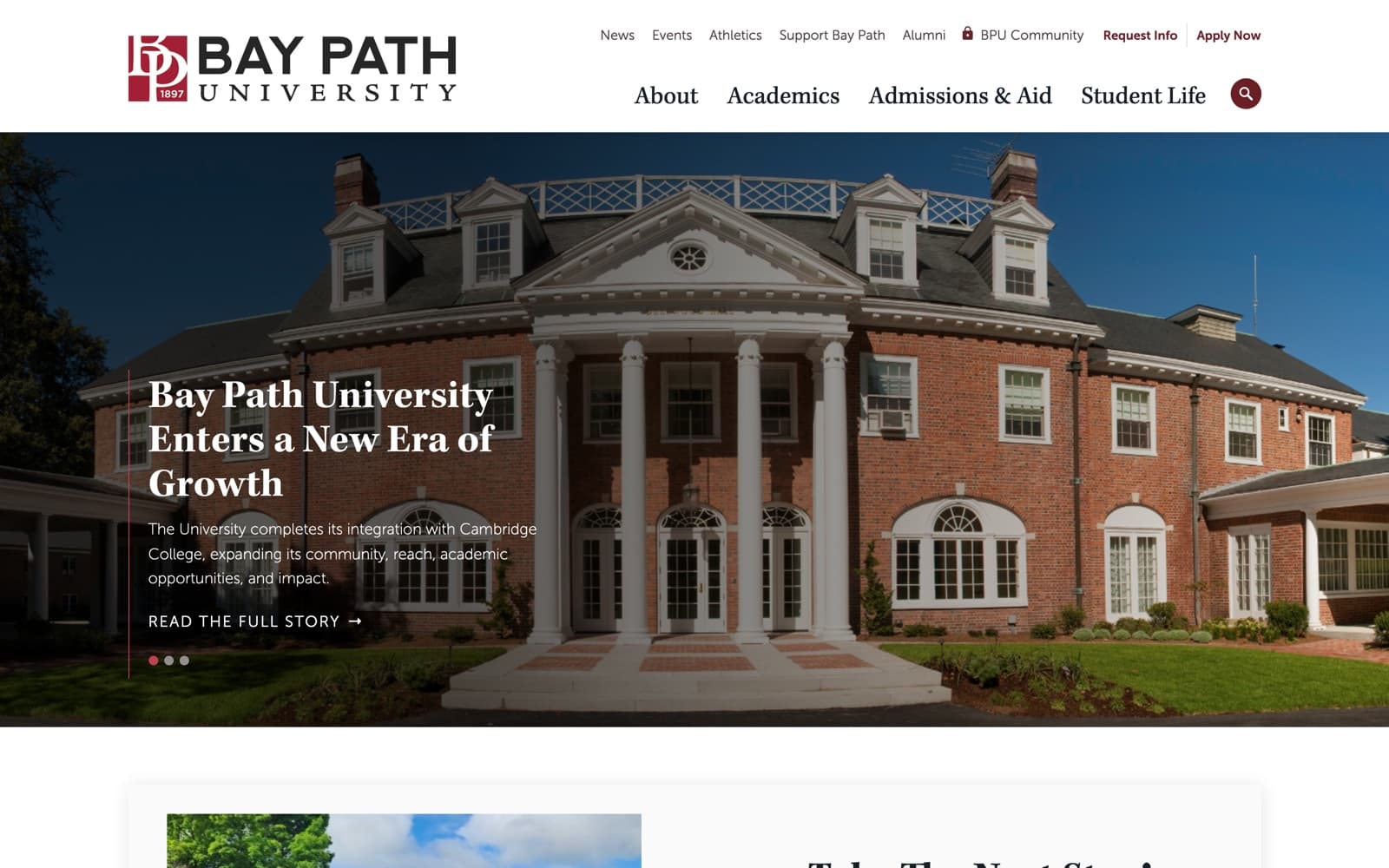
The public site for an independent Massachusetts university, where a prospective student finds a programme, works out which delivery version of it applies to them, and who to ask.
What they came with
A prospective student arrives wanting one subject, then has to work out which version of it applies to them: the one taught on campus, the online one, or the one running in Boston. Each version sits at a different URL shape and ends in a different contact, a named admissions counsellor on one path and the admissions office on another, so landing on the wrong variant costs the university the conversation it wanted. Undergraduate and graduate study describe themselves in different vocabularies, which a single search box on the home page has to reconcile. The Cambridge College acquisition then added instructional locations across greater Boston and Puerto Rico, along with a further set of graduate programmes, all of which had to appear in the finders without breaking the links already in circulation.
What the build had to do
One degree, several URL shapes
A subject splits into children under its own availability path, one adds a third sibling for its Boston version at a nested path, and another exists as a separate top-level record. Each variant ends in a different contact: a named admissions counsellor with a phone number and a booking link on the online and Boston pages, the admissions office on the campus one.
Two of three filters run in the browser
Keyword and topic are request parameters that re-render the finder, while availability and degree type are applied client-side against classes stamped on each result card. Every programme therefore carries its full classification in the markup, and the availability facet is rendered twice on one page, as a select and as a button row, both driving the same filter.
Two finders, two vocabularies
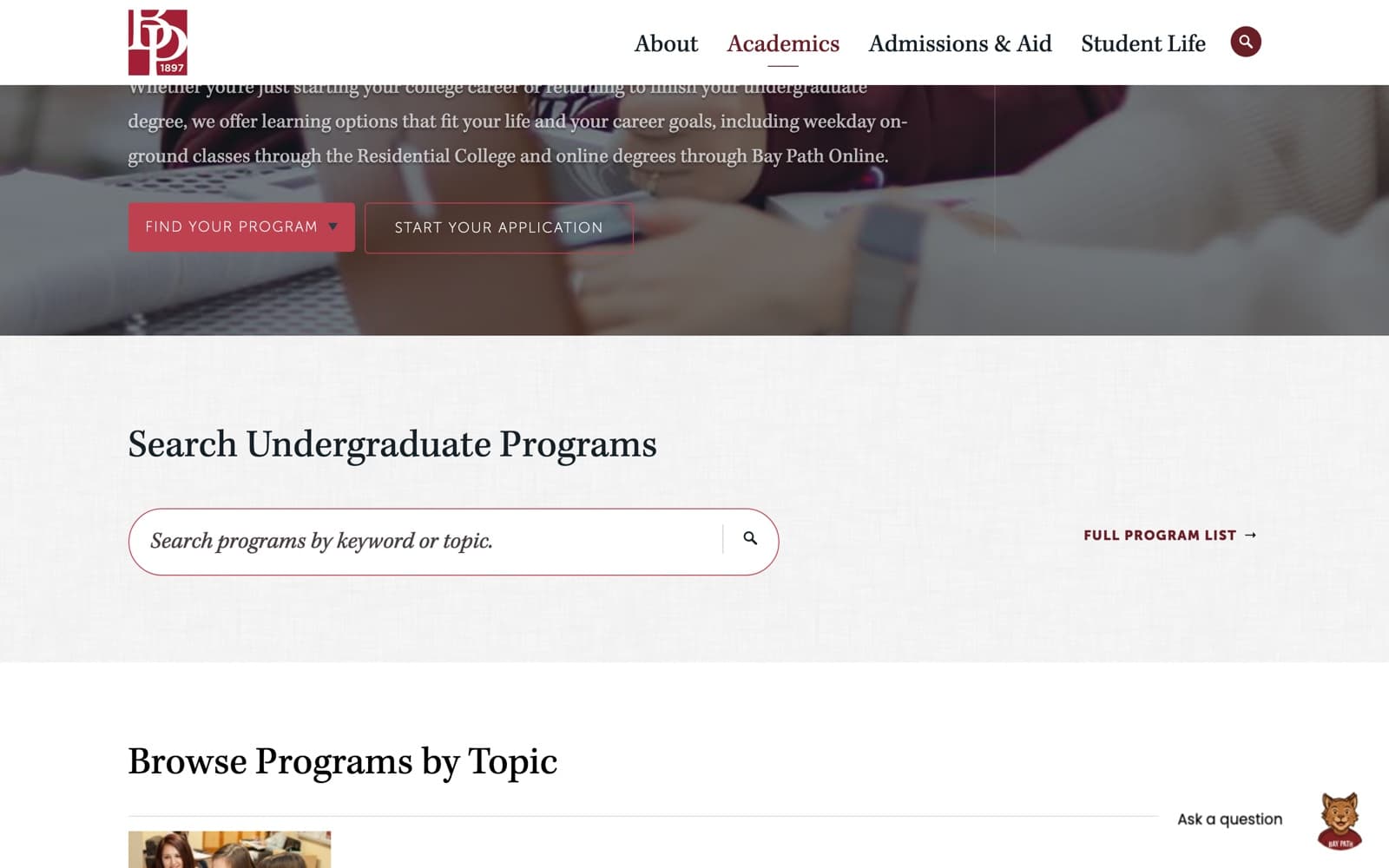
The undergraduate finder filters on residential, online, Boston and Puerto Rico with degree types from AA to ASN; the graduate one filters on a different set of locations with EdD, DNP, MBA and OTD among its types. The home page carries a single search box that rewrites its own form action depending on which of the two the reader has toggled.
Locations that arrived with an acquisition
The Cambridge College acquisition added instructional locations in the greater Boston region and Puerto Rico along with more than fifty graduate programmes. Both finders had to take those on without disturbing the URLs already in circulation or the pages that describe the original campuses.
Faculty tagged by programme, both ways
Each record carries a school, a title, degrees, an email and one or more programme tags, and that tag list drives two things: the directory's programme dropdown and the faculty page hanging off each programme. The undergraduate tree and the graduate tree even name that page differently, so both routes have to resolve.
Technical detail
Filtering split across two tiers
Keyword and topic are request parameters that re-render the finder, so those two survive being copied out of the address bar and shared. Availability and degree type are applied in the browser against classes stamped on each result card, which takes the click off the network but requires every programme to carry its full classification in the markup on first load.
One facet, two controls, one state
Availability is rendered twice on the same page, once as a select and once as a row of buttons, and both drive the same filter. The two controls read and write a single piece of state, so a choice made in either is reflected in the other rather than each keeping its own idea of what is selected.
Two finders, two taxonomies, one entry
The undergraduate finder filters on residential, online, Boston and Puerto Rico with degree types from AA to ASN, while the graduate one carries a different location set and types including EdD, DNP, MBA and OTD. The home page keeps one search box that rewrites its own form action depending on which is toggled, so neither tree is forced into a shared vocabulary that fits neither.
Faculty tags resolve both trees
Each faculty record carries a school, a title, degrees, an email and one or more programme tags, and that tag list feeds both the directory's programme dropdown and the faculty page hanging off each programme. The undergraduate and graduate trees name that page differently, so both routes resolve to the same tag query rather than to two hand-kept lists that drift apart.
The stack
CMS
Frontend
Infrastructure
- Sector
- Independent university
- Audience
- Prospective students, campus and online
- Shape
- Two programme finders plus directories
- Platform
- BigTree CMS, PHP, nginx
Something like this to build?
Tell us what runs today and where it hurts. An engineer reads it and replies.