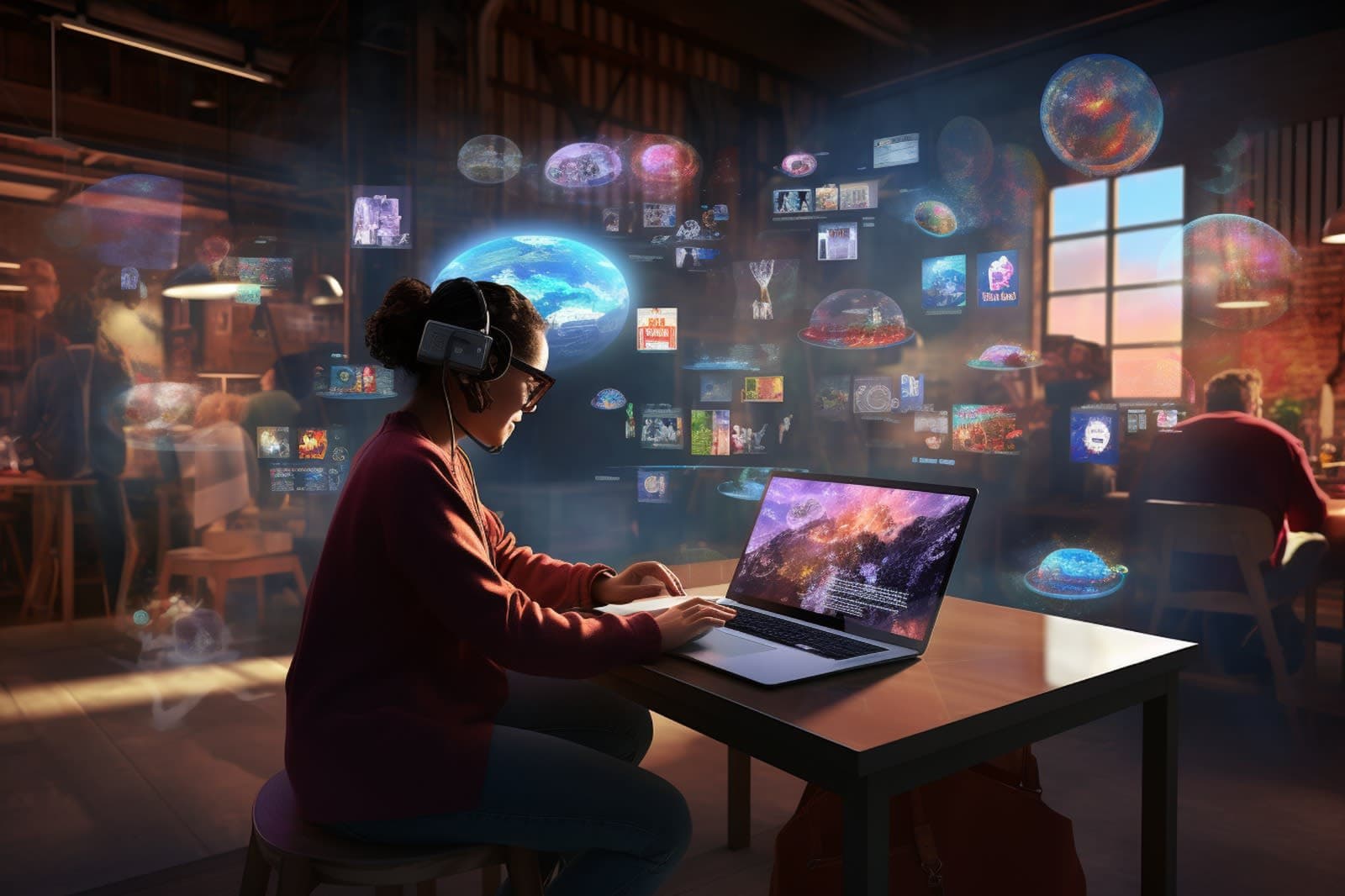
A small studio can now ship a game whose NPCs hold a real conversation and whose world assembles itself while the player walks through it. The models are open source, free to download, and small enough to run on hardware the studio already owns. That last part is what changed. Not long ago the same capability sat behind a research department and a budget to match. Villaex Technologies works with studios on getting these models into a production pipeline. The point is smarter gameplay without a proportional rise in production cost.
What Open Source AI Means in a Game Pipeline
Open source AI means machine learning models, libraries and frameworks that are free to download, modify and ship inside a commercial product. There is no license negotiation, no per-call pricing that scales with your player count, and no vendor deciding what your NPC is allowed to say. A studio can fine-tune a model on its own writing and keep the weights in house. That matters when the thing being tuned is the voice of a character the studio spent three years building.
The tools that turn up most often are narrow and well understood by now. GPT-J and GPT-NeoX generate dynamic NPC dialogue. Stable Diffusion produces procedurally generated art and textures. OpenAI Whisper handles speech-to-text, which is how a player talks to a game rather than at it. RLlib and OpenAI Gym cover reinforcement learning on agent behavior, and Unity ML-Agents and the Godot AI plugins put AI-controlled agents inside a real-time engine, where they keep to a frame budget like everything else in the scene.
NPCs That Stop Repeating Themselves
The gap between a character and a vending machine with a face has always been dialogue. A scripted NPC owns a fixed set of lines and the player hears all of them soon enough, at which point the illusion collapses and the character becomes a button you press for a quest. Language models change the arrangement, because conversation is generated against what the player has done, where they are standing and what the character is supposed to know. The lines stop repeating. It is a small technical claim with a large design consequence: the writer's job moves from scripting every branch to defining who a character is and what they would never say.
Behavior is the second piece, and it develops on a slower clock. Reinforcement learning frameworks let an NPC adjust over a campaign, learning from how one player fights or trades and changing strategy in response, so difficulty stops being a global setting and becomes something the world negotiates with you. Layer an emotion model on top and the character shows anger, fear, joy or doubt in a way that reads as a person reacting rather than a state machine flipping a flag. Goal-oriented agents go further by giving NPCs something to want. A guard protecting territory or a trader hunting a resource behaves with intent, and intent is most of what makes a world feel inhabited while the player is somewhere else.
Voice is the last layer. It used to be out of reach entirely. Tools like Bark and Coqui synthesize expressive NPC speech, which puts voiced characters within range of a studio that cannot afford a casting session.
Worlds That Assemble Themselves
Procedural generation builds content algorithmically: terrain, cities, quests, lore. The classic techniques, Perlin noise and Wave Function Collapse among them, produce variety reliably but they do not produce meaning, which is why a purely procedural landscape reads as weather rather than as a place. Combine them with AI and the output starts making narrative sense, so a valley has a reason to sit where it does and a ruin has a reason to have been abandoned. The difference shows up in how long a player keeps exploring before deciding the map is only noise.
Quests can be generated against the player's own history: what they decided last chapter, what is in their inventory, where they are standing when the game needs something to happen. Visual work benefits more obviously. Stable Diffusion generates textures, interface elements and concept art from prompts, and audio tools compose ambient beds and tension cues on the fly instead of looping the same four bars. Narrative models fill in the rest: backstory, cultural detail, the small unimportant lore that makes a corner of a generated world feel like somebody once lived there.
Why Open Models Beat a Hosted API, and What They Cost
Cost is the obvious answer and the least interesting one. It is not nothing: usage-based pricing on a hosted API is unpredictable in a game whose player count can double overnight on one video. The stronger reasons are control and privacy. An open model can be tuned to the tone and internal logic of one specific game in a way a general-purpose API cannot. It can be hosted offline or run on-device, which keeps intellectual property inside the studio and cuts inference latency. The code is inspectable, so a team can say why a decision came out as it did, and the community improves these models faster than most vendors ship a release.
None of this is plug-and-play. The recurring problems are model optimization for real-time use, memory and performance headroom on lower-end devices, thin debugging and explainability tooling, and keeping AI-generated output consistent with a game's own logic and lore. The fixes are mostly engineering discipline. Quantized models and edge-friendly language models get inference inside the frame budget. Profiling and A/B testing frameworks show what a model costs at runtime rather than what a benchmark promised, and a lore database gives narrative AI a source of truth to check itself against. Full-cycle DevOps and MLOps support keeps model versions under control once the game is live.
Where a Small Team Starts, and Where This Goes
Five moves cover most of what a small studio gets out of open models: branching real-time conversation from a language model, evolving behavior through reinforcement learning, custom voices from text-to-speech, emotion-driven responses in combat or negotiation, and goal-based reasoning so agents act with a purpose of their own. Pick one. Ship it, watch what it does to the game, and add the next in the following milestone. Attempting all five in a single production is how a studio ends up with five half-finished systems.
We build custom AI engines at Villaex, from open-source NLP through to in-game decision systems, and package smart NPC modules that drop into Unity, Unreal or a custom engine. On the content side we set up procedural generation pipelines that automate level design, asset creation and quest generation. We also handle voice and chatbot integration for multilingual characters, plus the infrastructure to deploy models at low latency.
What arrives next is already visible in outline. Generative 3D is coming through tools like Kaedim AI and NVIDIA Omniverse. Persistent characters that remember a player across sessions are close, and so are real-time voice translation for NPCs, AI dungeon masters running RPG sessions, and behavior prediction that shapes a story around how one person likes to play. Open source AI has stopped being a trend. It is the foundation a great deal of interactive storytelling now rests on. You no longer need a hundred-person team to build a deep, dynamic world. A small studio with the right models can generate smarter NPCs, build content procedurally and personalize the experience in ways that were out of reach a couple of years ago.
Building something like this?
Tell us what runs today and where it hurts. An engineer reads it and replies.